Types of Plastic: Groups, Codes and Uses
Filter 23 plastics by group, thermoplastic or thermoset, or search by name or use to see its recycling code and typical products.
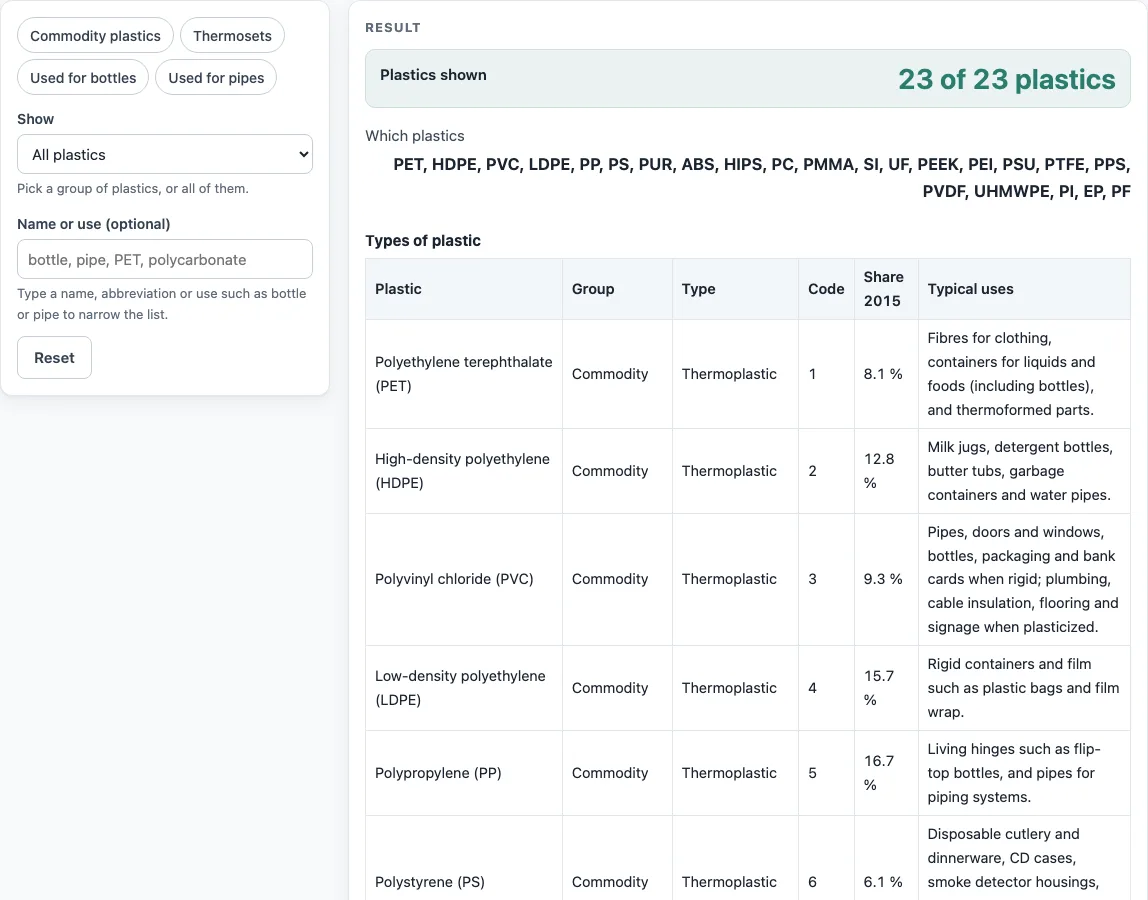
How to use the Types of Plastic tool
- Open the Show drop-down and choose a group: All plastics, Commodity plastics, Engineering plastics, High-performance plastics, Thermoplastics or Thermosets.
- Click the Name or use (optional) box and type a name, abbreviation or use, such as bottle or pipe, to narrow the list.
- Or click a chip: Commodity plastics, Thermosets, Used for bottles or Used for pipes.
- Read the Plastics shown count to see how many of the 23 plastics match.
- If exactly one plastic matches, check its Group, Thermoplastic or thermoset, Recycling code, Share of 2015 production and Typical uses.
- Use the table to compare every match by name, group, type, code, 2015 share and uses.
- If nothing matches, the tool says so. Try a shorter word, or set Show back to All plastics.
- Open “How it was calculated” to see which filter and search were applied and how many plastics matched.
The search looks at each plastic’s name, abbreviation and the uses written for it, and every word you type must match. A search for “water pipes” therefore finds HDPE, whose uses include water pipes, but not PVC, whose uses name pipes without the word water.
Copy result copies the result lines with a link. Copy link stores your filter and search in the address, so you can share the same view. Print / save result prints the current result.
What is the difference between thermoplastic and thermoset plastic?
Thermoplastics can be melted and reshaped again and again. Thermosets can take shape only once. The difference comes from what happens when the material is heated.
Thermoplastics do not undergo a chemical change in their composition when heated, so they can be molded repeatedly. Polyethylene (PE), polypropylene (PP), polystyrene (PS) and PVC are examples. Thermosets can melt and take shape only once. After they solidify, they stay solid, and if they are reheated they decompose rather than melt. Epoxy resin, polyimide and Bakelite are examples. The article also uses vulcanized rubber to illustrate this kind of change during curing.
This split matters when you sort or reuse plastic. A thermoplastic can be melted down and remolded, while a thermoset cannot. The Thermosets chip and the Thermoplastics option in the Show drop-down let you view each group.
What are commodity plastics?
Commodity plastics are made in high volumes for packaging, food containers and household products. They are inexpensive, but their mechanical properties are relatively weak. Together they make up about 80 % of global plastic production, so they are the plastics you meet most often.
Engineering plastics are more robust and are used for vehicle parts, construction and machine parts. High-performance plastics resist high temperatures, often above 150 °C, as well as chemicals and wear.
Some plastics fall into more than one group. The article calls PMMA (acrylic) both a commodity and an engineering plastic, and the tool files it under engineering.
Production shares show where the commodity plastics sit. In 2015, out of 407 million tonnes, polypropylene made up 16.7 %, LDPE 15.7 % and HDPE 12.8 %.
Sources
Checked October 2026:
- Wikipedia, Plastic: groups, thermoplastics and thermosets, 2015 production table, product lists
- Wikipedia, Resin identification code: codes 1 to 6
- Wikipedia, Polyethylene terephthalate: uses of PET
- Wikipedia, Polyvinyl chloride: uses of PVC
- Wikipedia, Polystyrene: uses of PS
Worked examples
| Input | Result |
|---|---|
| all plastics | 23 of 23 plastics |
| thermosets | 5 of 23 plastics |
| all plastics, "bottle" | 4 of 23 plastics |
| commodity plastics, "pipe" | 3 of 23 plastics |
Calculated by the tool above with these values.
Frequently asked questions
What are the main types of plastic?
Using the 2015 production shares in the article, the largest are polypropylene (16.7 %), LDPE (15.7 %), HDPE (12.8 %), PVC (9.3 %), PET (8.1 %), polyurethane (6.6 %) and polystyrene (6.1 %). The tool’s Share of 2015 production column shows these figures for each plastic.
What are engineering plastics?
Engineering plastics are a group of plastics that are more robust than commodity plastics. The article names vehicle parts, construction and machine parts as their main uses. PMMA is filed under this group in the tool.
Which plastics have a recycling code?
The codes from ASTM D7611 are PET 1, HDPE 2, PVC 3, LDPE 4, PP 5 and PS 6. Polyurethanes have no code. Plastics outside that list have no code in the 1 to 6 range.
Why does a result say “Not stated in the sources used”?
The sources do not say whether HIPS, silicone, PTFE and PPS are thermoplastics or thermosets. The tool shows this message rather than guessing.
What does the Share of 2015 production column mean?
It is the plastic’s share of all plastics made worldwide in 2015, from the production table in the Wikipedia article “Plastic”. The table covers LDPE, HDPE, PP, PS, PVC, PET and polyurethane, so other plastics show a dash.
What does a result look like when only one plastic matches?
Searching “peek” returns one match: Polyetheretherketone (PEEK). It is in the High-performance group and is a thermoplastic. It is described as strong and chemical- and heat-resistant, and its listed uses are medical implants and aerospace moldings.
Related tools
- Recycling symbols chart: use it when you need to match a symbol on a product to its resin code.
- Plastic density chart: use it when you need to compare how heavy different plastics are by volume.
- Plastic melting point chart: use it when you are comparing the temperatures at which plastics soften or melt.
- Plastic weight calculator: use it when you need to estimate the weight of a plastic part.
- Shore hardness chart: use it when you are comparing how hard or soft different materials are.
- Filament calculator: use it when you are working out how much 3D printing filament a project needs.