Trash Bag Size Chart and Calculator
Measure your trash can to get the flat width and length of the bag that fits it, with the overhang you want.
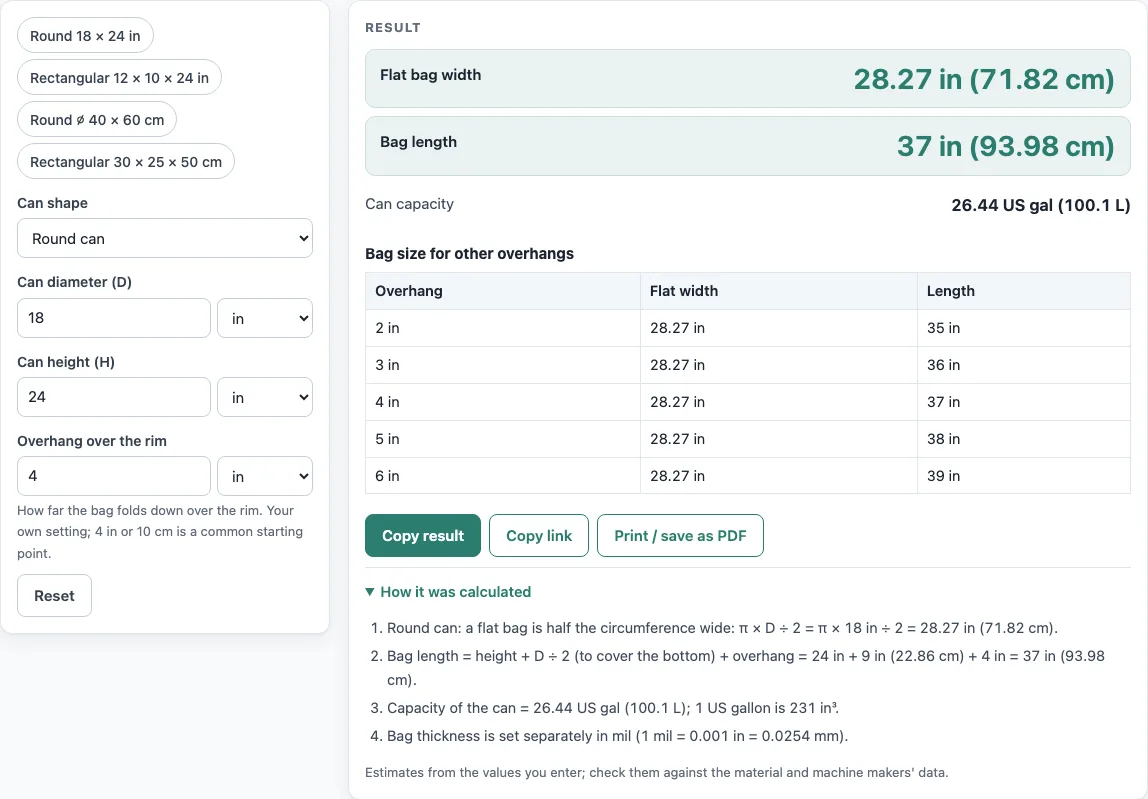
This trash bag size chart calculator shows the flat width and length of a garbage bag or trash can liner that fits your can. Measure your can, enter its shape and size, and the bag dimensions appear as you type. It runs free in your browser with no sign-up, and it works on a phone.
The tool handles round cans as well as square and rectangular ones. You can choose how far the bag overhangs the rim, and the can’s capacity appears in US gallons and litres. Sizes are listed as flat width × length, so you can compare a measured result with the bags you plan to buy.
How to use the Trash Bag Size Chart
- Measure your can. For a round can, measure the diameter across its widest point. For a square or rectangular can, measure the width and depth. Then measure the height from the base to the rim.
- Choose the can’s shape: round, or square/rectangular.
- Enter the diameter, or the width and depth, in the unit you measured in.
- Enter the height in the same unit.
- Set the overhang. The default is 4 in (10 cm). Use the overhang table, which shows 2–6 in (5–15 cm), to compare other values.
- Read the flat width × length in the results. They update as you type, so change an input and watch the bag size shift.
- Open “How it was calculated” to see the formula and each step worked out with your numbers.
When the result is right, use Copy result to copy the result lines with a link. Copy link copies the page address, which stores every input in the URL (?s=…), so opening it later restores the same calculation. Print / save as PDF prints your inputs, results, calculation steps and the date, which is useful for a job sheet or a record.
The presets show an 18 × 24 in round can, a 12 × 10 × 24 in rectangular can and two metric cans.
What size trash bag fits my can?
A bag fits when its flat width is at least half the can’s distance around, and its length covers the can’s height, its base, and the overhang above the rim. Two cans with the same capacity can have different shapes, so the gallon number on a box does not confirm fit. Compare the bag’s flat width × length with the calculated size.
How do you measure a trash can for a liner?
For a round can, measure the diameter across the widest point. For a square or rectangular can, measure the width and the depth. Measure the height from the base to the rim, and use one unit for all three numbers. Measure the can you will actually line, since a lid, handle or dent can change what fits.
How do you calculate trash bag size?
For a round can with diameter D and height H, the flat width is π × D ÷ 2, which is half the circumference. The length is H + D ÷ 2 + overhang. The D ÷ 2 part covers the bottom, and the overhang is the extra length that folds over the rim. For a round can 18 in across and 24 in high, the width is 28.27 in and the length is 24 + 9 + 4 = 37 in.
For a square or rectangular can with width W and depth D, the flat width is W + D, which is half the perimeter. For the length, use half the diagonal of the can bottom instead of half the diameter, as the NASSCO can-liner guide does. For a 12 × 10 in can that is 24 in high, the width is 12 + 10 = 22 in, the bottom diagonal is √(12² + 10²) ≈ 15.6 in, and the length is 24 + 7.8 + 4 ≈ 35.8 in.
What size bag for a 13 gallon can?
A US gallon is 231 cubic inches, so 13 gallons is 13 × 231 = 3,003 cubic inches. That volume does not give you the width or length of a bag, because cans with the same capacity can be different heights and widths. Enter your can’s measurements into the tool, and the flat width and length show the bag size to look for.
What size bag for a 55 gallon drum?
A 55-gallon drum holds 55 × 231 = 12,705 cubic inches. Most 55-gallon drums are round, so use the round-can rule: flat width = π × D ÷ 2, and length = H + D ÷ 2 + overhang. Measure the drum’s diameter and height, enter them, and read the result.
Sources
Checked October 2026:
- Interplas, How to measure for a can liner and NASSCO can-liner guide: width = half the circumference, length = height + half the bottom (diagonal for a rectangular can) + 3 to 4 in overhang
- NIST SP 811 and NIST Handbook 44 appendix C for unit conversions (1 in = 25.4 mm, 1 US gal = 231 in³)
For estimation; verify critical designs against the applicable standard.
Worked examples
| Input | Result |
|---|---|
| ⌀ 18 in × 24 in | 28.27 in (71.82 cm) wide × 37 in (93.98 cm) long |
| 12 × 10 in × 24 in | 22 in (55.88 cm) wide × 35.81 in (90.96 cm) long |
| ⌀ 40 cm × 60 cm | 24.74 in (62.83 cm) wide × 35.43 in (90 cm) long |
| 30 × 25 cm × 50 cm | 21.65 in (55 cm) wide × 31.31 in (79.53 cm) long |
| ⌀ 1.5 ft × 2 ft | 28.27 in (71.82 cm) wide × 37 in (93.98 cm) long |
Calculated by the tool above with these values.
Frequently asked questions
How much overhang should I allow?
The default is 4 in (10 cm). The overhang table shows 2–6 in (5–15 cm) if you want to compare other values. More overhang gives you more bag to fold over the rim, and less overhang gives a shorter bag.
Does bag thickness change the size?
No. Thickness is measured in mil and is chosen separately for strength. To convert mil to mm, use the mil to mm converter.
What units can I measure in?
Results are shown in inches and centimetres, and the can’s capacity is shown in US gallons and litres. You can enter measurements in inches, centimetres or feet, as the feet example shows.
Can I use the results in a quote or price list?
Yes. Results may be used in commercial work, such as quotes, price lists, job sheets and reports, without attribution.
Is the bag width the flat width?
Yes. Bags are sold by flat width × length, measured lying flat, and the calculator gives the flat width.
Can I use it for a recycling bin or a drum?
Yes. Any round or rectangular container works: measure its diameter (or width and depth) and height.
Why is my bag too short even though the width fits?
The length must cover the height, the bottom (half the diameter or depth) and the overhang; a deep can needs a longer bag than its capacity suggests.
Related tools
- Mil to mm converter: Use it when you need to convert a bag’s thickness from mil to millimetres.
- Recycling symbols chart: Use it to check the recycling symbols printed on plastic packaging and bags.
- Plastic weight calculator: Use it to estimate how much plastic is in a bag or sheet.
- Plastic density chart: Use it to look up the density of common plastics for weight calculations.
- All calculators: Use it to browse every calculator on this site.