Shore Hardness Chart: Shore 00, A and D Durometer Scales
Enter a durometer reading to see where it sits among everyday items, its rough equivalent on the other scale and an approximate modulus.
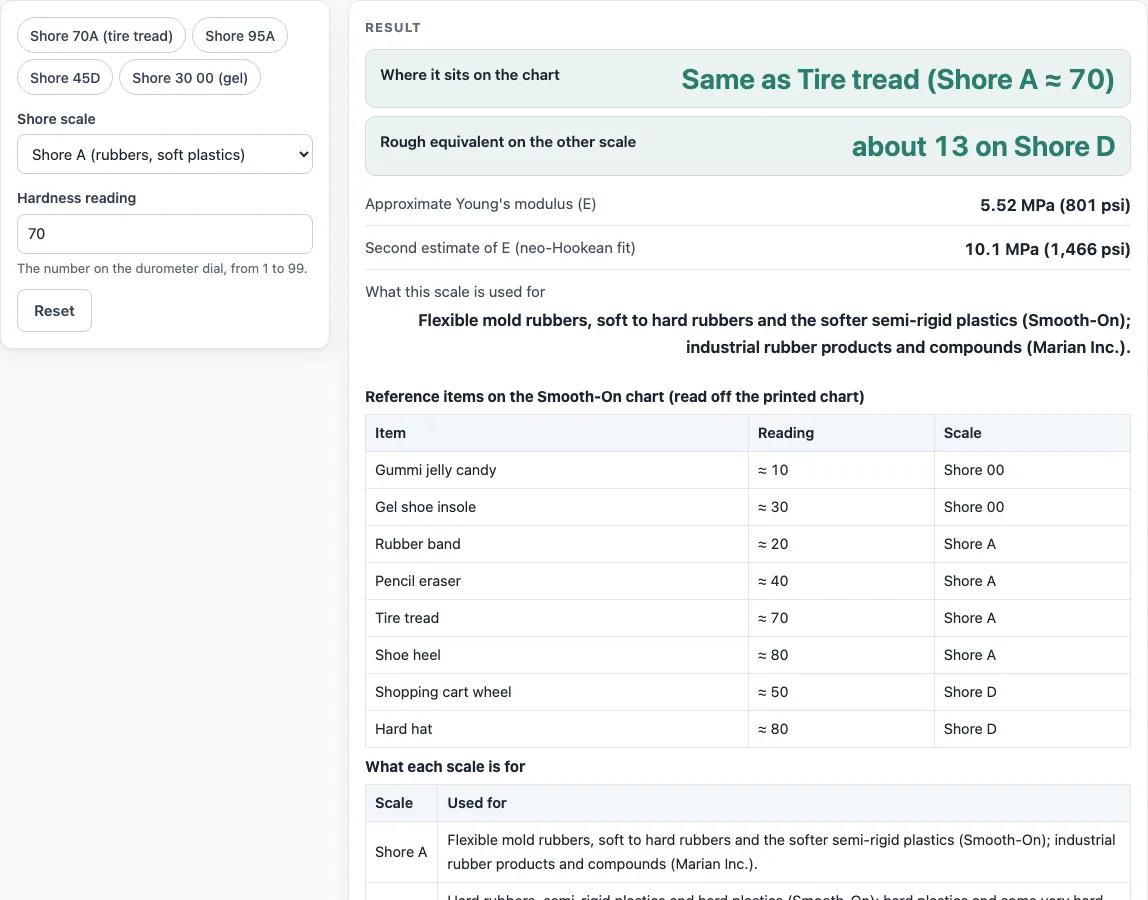
How to use the Shore hardness chart
- Open ‘Shore scale’ and pick Shore A (rubbers, soft plastics), Shore D (hard rubbers, plastics) or Shore 00 (gels, very soft rubbers). Choose the scale named on your datasheet or durometer.
- Type the number from the durometer into ‘Hardness reading’. It must be above 0 and below 100.
- Read ‘Where it sits on the chart’ to see which reference items your reading falls between.
- For Shore A and Shore D, read ‘Rough equivalent on the other scale’.
- For Shore A and Shore D, read ‘Approximate Young’s modulus (E)’ in MPa and psi. When a second estimate is available it appears in ‘Second estimate of E (neo-Hookean fit)’.
- Read ‘What this scale is used for’ and any warning shown under the result.
- To try the page quickly, simply press ‘Shore 70A (tire tread)’, ‘Shore 95A’, ‘Shore 45D’ or ‘Shore 30 00 (gel)’.
‘How it was calculated’ shows each step with your numbers. ‘Copy result’ copies the output, ‘Copy link’ keeps your inputs, ‘Print / save as PDF’ prints the inputs, results, steps and date, and ‘Reset’ clears the form. Reference tables below the result list the chart items, the use of each scale and typical durometers of common materials.
What is the Shore hardness chart for rubber (Shore 00, A, D)?
The chart uses three scales. Shore 00 covers very soft rubbers and gels, and is also used for sponge rubber and foams. Shore A covers flexible mold rubbers, soft to hard rubbers and the softer semi-rigid plastics. Shore D covers hard rubbers and hard plastics.
What is Shore A hardness of a rubber band, tire or eraser?
On the manufacturer’s chart this page uses, a rubber band sits at about 20 on Shore A, a pencil eraser at about 40 and tire tread at about 70. These positions were read off a printed graphic, so they are approximate. A separate table taken from Wikipedia lists typical values for common materials, such as 25 A for a rubber band and 55 A for a door seal. Different sources give different numbers for the same item.
How do I convert Shore A to Shore D?
There is no standard conversion between Shore A and Shore D. The tool turns your reading into a Young’s modulus with a published relation, then turns that modulus into the other scale with a second relation (Gent 1958 and Qi 2003, as quoted by Wikipedia). For example, 95 A comes out at about 44 D, and 45 D comes out at about 95 A. This durometer conversion chart is only a rough guide, and it does not convert Shore 00.
What Shore hardness do TPU, EPDM and gasket rubbers have?
It depends on the grade, and this page has no table for TPU or EPDM. Read the value from the datasheet and enter it with the right scale. For reference, the Wikipedia table lists hydraulic O-rings at 70–90 A and pneumatic O-rings at 65–75 A.
What is the difference between Shore A and Shore D?
They are separate scales for softer and harder materials, so the same number does not mean the same hardness. By this tool, 45 D is about 95 A, while 45 A is only about 6 D. Use the scale your datasheet names.
Sources
Checked October 2026:
- Smooth-On, Shore Hardness Scales chart and its durometer page: the reference items, what each scale measures, and the one printed pair, 95A = 45D
- Marian Inc., durometer comparison: typical use of Shore 00, A and D
- Wikipedia, Shore durometer: typical durometers of common materials, the note that no simple conversion between scales exists, and the Gent (1958) and Qi, Joyce and Boyce (2003) relations between hardness and Young’s modulus as quoted there (the original papers were not opened)
Worked examples
| Input | Result |
|---|---|
| Shore A 70 | Same as Tire tread (Shore A ≈ 70); about 13 on Shore D; E ≈ 5.52 MPa (801 psi) |
| Shore A 95 | Harder than the hardest chart item on this scale: Shoe heel (Shore A ≈ 80); about 44 on Shore D; E ≈ 43.8 MPa (6,357 psi) |
| Shore D 45 | Softer than the softest chart item on this scale: Shopping cart wheel (Shore D ≈ 50); about 95 on Shore A; E ≈ 46.5 MPa (6,748 psi) |
| Shore 00 30 | Same as Gel shoe insole (Shore 00 ≈ 30) |
| Shore A 50 | Between Pencil eraser (Shore A ≈ 40) and Tire tread (Shore A ≈ 70); about 7 on Shore D; E ≈ 2.46 MPa (356 psi) |
Calculated by the tool above with these values.
Frequently asked questions
What does 70A mean?
70A is a Shore A durometer reading of 70. A higher number means a harder material. Tire tread sits at about 70 A on the chart, and the tool gives about 13 on the Shore D scale for it.
Is Shore 00 softer than Shore A?
Shore 00 is meant for softer materials than Shore A, such as gels and sponge rubber. The chart places gummi jelly candy at about 10 on Shore 00 and a rubber band at about 20 on Shore A, but the numbers on different scales cannot be compared directly. The tool does not convert Shore 00 readings.
How do I convert Shore hardness to Young’s modulus?
Enter a Shore A or Shore D reading and read ‘Approximate Young’s modulus (E)’. It uses Gent’s relation for Shore A and the Qi relation for Shore D. For 70 A it gives about 5.52 MPa, while the second estimate gives 10.1 MPa, so the two can differ by almost a factor of 2.
Why is a reading below 10 or above 90 not reliable?
Durometer results near the ends of a scale are less dependable, so the tool warns you below 10 or above 90. Above 90 A the modulus estimate is very uncertain. If your reading falls at either end, test the material on the neighbouring scale.
Is the calculator free, and is anything I type uploaded?
Yes, the calculator is free, runs in your browser and needs no sign-up. Nothing you type is uploaded.
Related tools
- O ring groove size chart: use it to size the groove that holds an O ring once you know the seal’s hardness.
- O ring size chart: use it to look up standard O ring dimensions.
- Mil thickness chart: use it to compare sheet and film thicknesses in mils.
- Plastic density chart: use it to look up density values for common plastics.
- Plastic weight calculator: use it to estimate the weight of a plastic part from its volume.
- All calculators: use it to browse every calculator on this site.
- Foam density chart: use it for foam densities in lb/ft³ and kg/m³ and the ASTM C578 EPS and XPS types.