Recycling Symbols Chart (Plastic Codes 1–7)
Pick a number or type an abbreviation to see which plastic a resin identification code stands for and where it is used.
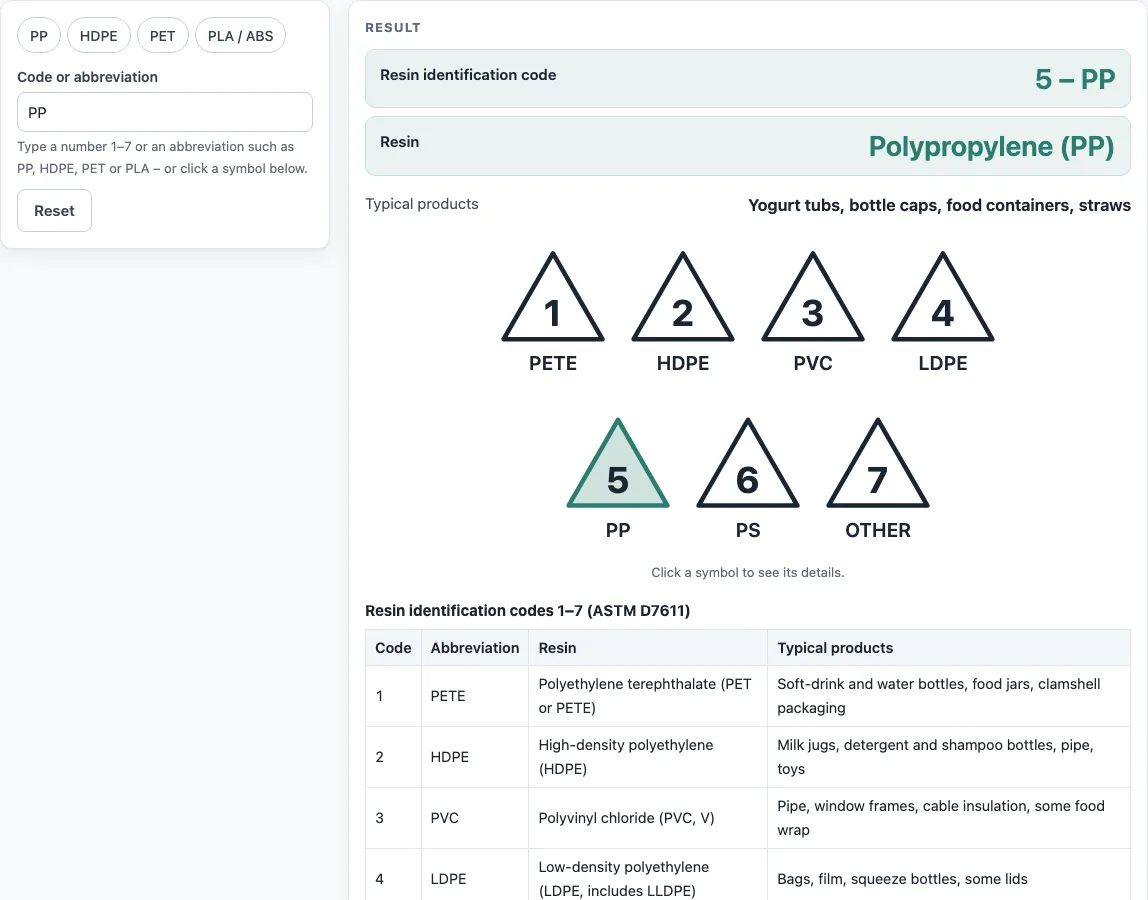
Recycling symbols chart is a free tool that tells you which plastic resin a recycling code refers to. Type a code number, an abbreviation such as PP or HDPE, or part of a resin name, and the result shows the code, the resin and its typical products. All seven symbols are drawn on the page, and you can click any of them. The tool runs in your browser with no sign-up, so nothing is uploaded. It is useful when you are sorting containers, checking packaging, or trying to understand the numbers printed on a product.
It explains all 7 types of plastic in one place.
How to use the Recycling symbols chart
- Click the search box at the top of the tool.
- Type what you know: a code number (such as 5), an abbreviation (such as PET), or part of a resin name (such as polyethylene).
- Watch the result update as you type. Each result shows the code, the resin and its typical products.
- Click any of the seven symbols to see the resin and products for that code.
- Open “How it was calculated” to see the lookup steps with your input.
Use Copy result to copy the result lines with a link. Use Copy link to copy the page address, which stores every input (?s=…), so opening it later restores the same lookup. Print / save as PDF prints the inputs, results, calculation steps and the date.
Click any of the seven triangle symbols to jump to that code, or type part of a name such as ‘poly’ to see every resin that matches. The presets show PP, HDPE, PET and PLA/ABS. The warnings under the result remind you that the code names the resin only, and that code 7 is a catch-all.
Search is not case-sensitive.
Each result also lists typical products for that resin, with the matching symbol highlighted.
What do the recycling numbers on plastic mean?
The numbers are resin identification codes from the ASTM D7611 standard, and each one names the type of plastic a product is made from. They exist so that plastics can be sorted by resin before recycling. A number tells you the resin, not whether your local programme will collect it.
What are the 7 types of plastic?
The seven codes are 1 PETE (polyethylene terephthalate), 2 HDPE (high-density polyethylene), 3 PVC (polyvinyl chloride), 4 LDPE (low-density polyethylene), 5 PP (polypropylene), 6 PS (polystyrene, including expanded foam), and 7 OTHER. Code 7 covers all other resins and multi-layer combinations, such as PC, PLA, ABS and nylon. If you are looking for a 7 types of recyclable plastic chart, this is that list, but the codes identify resins. They do not confirm that any type is accepted for recycling.
Which plastic numbers can be recycled?
The code alone does not decide it. Your local recycling programme sets its own list of accepted codes, and many programmes collect codes 1 and 2 most often. Check your local rules before deciding about codes 3 to 7. The symbol on an item tells you what resin it is made from, and your programme tells you whether to put it in the bin.
What plastic is number 5?
Number 5 is PP, or polypropylene. It is used for food containers, caps and straws. Type “PP” or “5” into the tool to see it listed with its products.
What does recycling code 7 mean?
Code 7 means OTHER: all resins that do not fit codes 1 to 6, plus multi-layer combinations. Typical products include everything else, such as mixed or layered packaging. PLA, a common 3D printing material, falls under 7. Because code 7 is a catch-all, it does not name the resin, so check the item or its maker to find out which plastic it is.
What plastic is number 1 and number 2?
Number 1 is PET (polyethylene terephthalate), used for drink bottles and food trays. Number 2 is HDPE (high-density polyethylene), used for household cleaner and detergent bottles and some food containers. These two are the resins most often accepted by kerbside programmes, but the code itself does not guarantee it.
Sources
Checked October 2026:
- Plastics Industry Association resin identification code table and ComplianceGate RIC guide for codes 1 to 7
- Wikipedia, Resin identification code for the 2013 change to the triangle mark; University of Illinois Extension for typical products
- US EPA recycling FAQ: a resin code does not mean the item is recyclable in your area
For estimation; verify critical designs against the applicable standard.
Worked examples
| Input | Result |
|---|---|
| "PP" | 5 – PP (Polypropylene (PP)) |
| "HDPE" | 2 – HDPE (High-density polyethylene (HDPE)) |
| "PET" | 1 – PETE (Polyethylene terephthalate (PET or PETE)) |
| "PLA" | 7 – OTHER (Other – all other resins and multi-layer combinations (O)) |
| "3" | 3 – PVC (Polyvinyl chloride (PVC, V)) |
Calculated by the tool above with these values.
Frequently asked questions
Why is the recycling symbol a triangle instead of arrows?
Since the 2013 ASTM D7611 update, the symbol is a solid equilateral triangle with the number inside, not chasing arrows. The change reflects that the code identifies the resin. The triangle does not mean the item is accepted by your local recycling programme.
Does a recycling number mean my town will collect the item?
No. The number identifies the resin only. Check with your local recycling programme for the codes it accepts.
What if my plastic does not match one of the seven codes?
Every code in the chart is either a named resin or code 7, which covers all other resins and multi-layer combinations. If an item is not clearly one of codes 1 to 6, treat it as 7 and check the item or its maker for the exact resin.
Does the tool work on a phone?
Yes. It works on a phone as well as a computer, so you can check a container while you are at the bin.
Can I use the results in my work?
Yes. Results may be used in commercial work, such as quotes, price lists, job sheets and reports, without attribution.
Is PLA recyclable with other plastics?
PLA carries code 7 and is not one of codes 1 to 6, so it is usually not collected with them; check your local programme.
Related tools
- Plastic density chart: use it to compare how dense different plastics are when you need values for a calculation.
- Plastic weight calculator: use it to estimate the weight of a plastic part from its size and material.
- Trash bag size chart: use it to find the right bag size for a bin.
- Mil to mm converter: use it to convert film thickness between mils and millimetres, for example when checking bags or wraps.
- All calculators: use it to browse every tool on the site.
- Plastic melting point chart: use it for the melting range and glass transition of common plastics.