Polyethylene vs Polypropylene Comparison
Compare HDPE, LDPE and polypropylene on melting range, density, recycling code, strength, chemical resistance and typical uses.
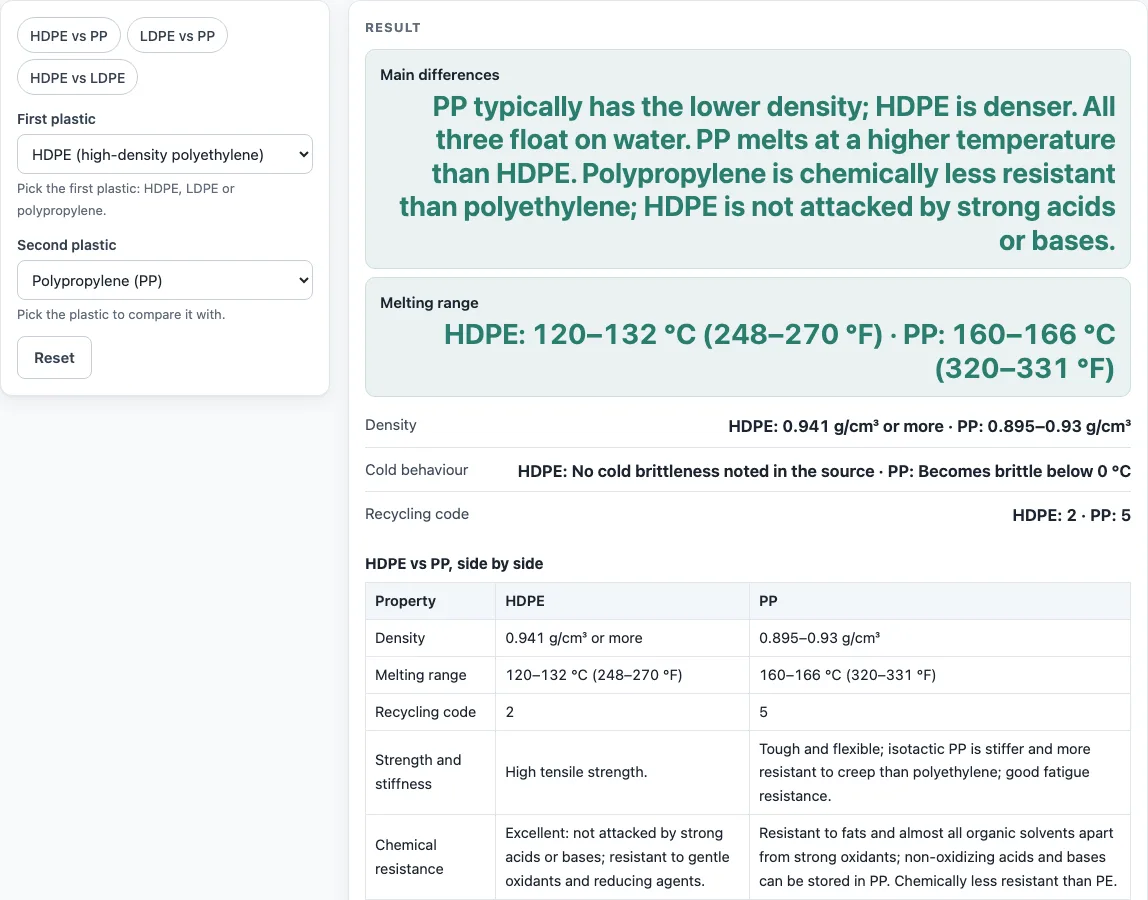
This polyethylene vs polypropylene tool compares two common plastics side by side. Choose two plastics and it shows their main differences, melting range, density, cold behaviour and recycling code, along with a table of strength, stiffness, chemical resistance and typical uses. Polyethylene here means HDPE or LDPE, and polypropylene (PP) is the third option, so you can compare any pair of the three. It runs in your browser, is free, needs no sign-up, and uploads nothing.
The numbers come from reference articles and show typical values. Grade, molecular weight, comonomer, crystallinity and additives all shift them, so check the data sheet for a specific product when you need exact figures.
How to use the Polyethylene vs Polypropylene Tool
- Open the First plastic drop-down and choose HDPE (high-density polyethylene), LDPE (low-density polyethylene) or polypropylene (PP).
- Open the Second plastic drop-down and choose a different plastic.
- Or click one of the chips to load a ready-made pair: HDPE vs PP, LDPE vs PP, or HDPE vs LDPE.
- Read the result panel. It lists the Main differences, the Melting range in °C and °F, the Density, the Cold behaviour and the Recycling code.
- Scroll to the table below the panel. It lists density, melting range, recycling code, strength and stiffness, chemical resistance and typical uses for both plastics.
- Compare the two columns line by line, and note which value matters most for your use.
- Read the warning under the result: the figures are typical ranges, so use your product’s data sheet when exact values matter.
- Open “How it was calculated” to see the density and melting range of each plastic that the result is built from.
Use Copy result to copy the result lines with a link to the comparison. Copy link stores both of your choices in the address, so you can share the exact pair. Print / save result prints the result or saves it as a file.
What is the difference between polyethylene and polypropylene?
Polyethylene (PE) is built from ethylene units, and polypropylene (PP) is built from propylene units. PP’s repeating unit carries an extra methyl group (CH₃). According to Wikipedia, that methyl group improves mechanical properties and thermal resistance, although chemical resistance decreases.
HDPE has a low degree of branching, so its mostly linear chains pack well and it has high tensile strength. LDPE has a high degree of branching, so its chains pack less well, which gives it lower tensile strength and more ductility. Wikipedia describes LDPE as softer and more transparent than HDPE.
Which has the higher melting point, polyethylene or polypropylene?
Polypropylene has the higher melting point. Commercial isotactic PP melts at 160–166 °C, while HDPE melts at 120–132 °C and LDPE at 105–115 °C.
PP’s melting point depends on how regular its chain is. Wikipedia gives 171 °C for perfectly isotactic PP, 160–166 °C for commercial isotactic PP, and 130 °C for syndiotactic PP with 30 % crystallinity. Polyethylene in the tool melts between 105 and 132 °C.
Is polypropylene or polyethylene more chemically resistant?
Polyethylene is generally more chemically resistant. Most LDPE, MDPE and HDPE grades are not attacked by strong acids or strong bases, and they resist gentle oxidants and reducing agents.
PP is less resistant than PE overall, but it still resists fats and almost all organic solvents. The main exception is strong oxidants. Non-oxidizing acids and bases can also be stored in PP.
Does polypropylene float on water?
Yes. Polypropylene has a density of 0.895–0.93 g/cm³, which is below the density of water (about 1 g/cm³). An object floats when its density is lower than the liquid it sits in.
HDPE and LDPE are also below 1 g/cm³, so all three float. Fillers can change the density of a compounded product, so check the data sheet for a filled grade.
What is the recycling code for polypropylene and polyethylene?
Polypropylene uses recycling code 5. HDPE uses code 2, and LDPE uses code 4.
These codes are resin identification codes, defined in the ASTM D7611 standard. They tell you which resin an item is made from. They do not tell you whether your local collection scheme accepts that plastic.
Sources
Checked October 2026:
- Wikipedia, Polyethylene: density definitions, melting points, chemical resistance, HDPE and LDPE properties and uses
- Wikipedia, Polypropylene: density, melting points, brittleness below 0 °C, chemical and mechanical properties, applications
- Wikipedia, Resin identification code: codes 2, 4 and 5
Worked examples
| Input | Result |
|---|---|
| HDPE vs PP | HDPE: 120–132 °C (248–270 °F) · PP: 160–166 °C (320–331 °F) |
| LDPE vs PP | LDPE: 105–115 °C (221–239 °F) · PP: 160–166 °C (320–331 °F) |
| HDPE vs LDPE | HDPE: 120–132 °C (248–270 °F) · LDPE: 105–115 °C (221–239 °F) |
Calculated by the tool above with these values.
Frequently asked questions
Can I compare HDPE with LDPE?
Yes. Both drop-downs offer HDPE, LDPE and polypropylene, so the chip HDPE vs LDPE loads that pair. The Main differences line then notes that both are polyethylene and share the same chemical resistance.
How do the strengths of HDPE, LDPE and PP differ?
The sources describe HDPE as having high tensile strength, and LDPE as having lower tensile strength and more ductility. Polypropylene is described as tough and flexible, and isotactic PP as stiffer and more resistant to creep than polyethylene. The tool gives these as text in the table, not as numbers.
Does polypropylene become brittle in the cold?
Yes. Wikipedia says PP becomes brittle below 0 °C. The Cold behaviour line shows this for PP, and says no cold brittleness is noted in the source for HDPE and LDPE.
What is polypropylene used for compared with polyethylene?
The typical uses named in the sources are milk jugs, detergent bottles, butter tubs, garbage containers and water pipes for HDPE; rigid containers and film such as bags for LDPE; and living hinges, such as flip-top bottle hinges, and piping systems for PP. The table lists them under Typical uses named in the source.
Are these melting points exact for my product?
No. They are typical ranges from reference articles. Grade, molecular weight, comonomer, crystallinity and additives all move them, so use the data sheet of your material for anything that matters.
Related tools
- Plastic density chart: Use it when you need the density of plastics beyond these three.
- Plastic melting point chart: Use it to compare melting points across a wider range of plastics.
- Recycling symbols chart: Use it to match a recycling code printed on a product to its plastic.
- Plastic weight calculator: Use it to estimate how much a plastic part weighs from its size and density.
- Shore hardness chart: Use it to compare how firm or soft different plastics feel.
- Trash bag size chart: Use it to pick a bag size once you know which plastic film suits your needs.