Plastic Weight Calculator
Choose a shape and a plastic, enter the dimensions and get the weight per piece, per length and for the whole order.
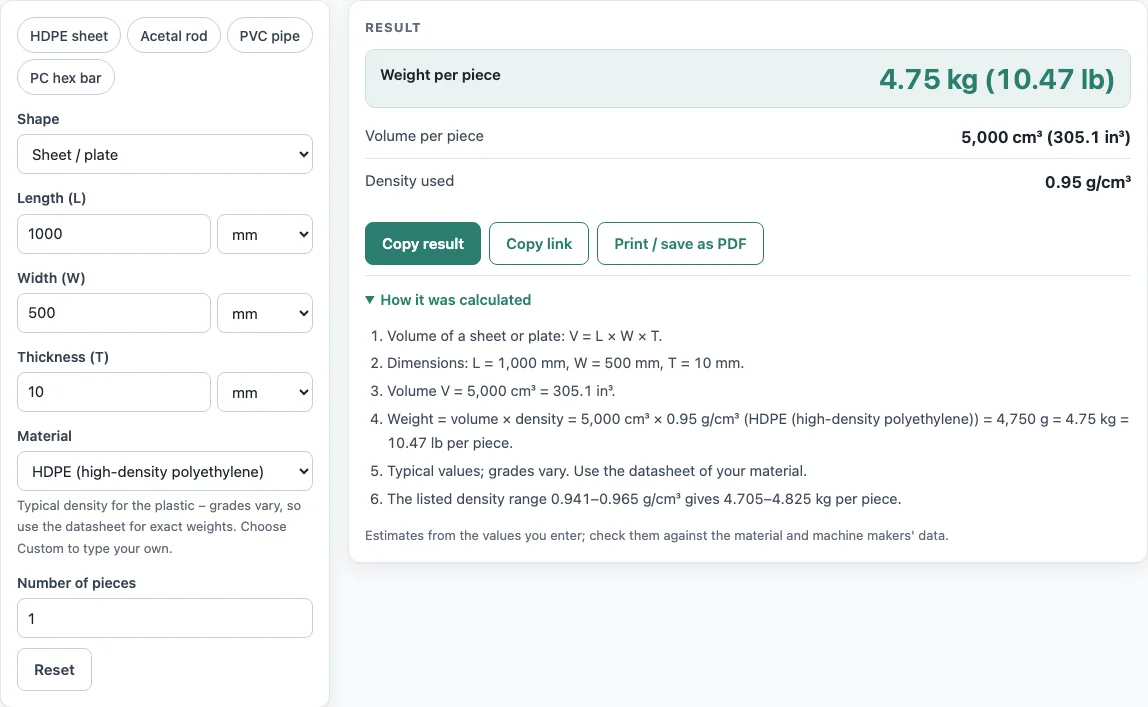
How to use the plastic weight calculator
- Choose a shape: sheet/plate, round rod, tube/pipe, square bar, hex bar or block.
- Enter the dimensions. For a sheet, type the length, width and thickness. For a round rod, type the diameter and length. For a tube or pipe, enter the outside diameter with the wall thickness, or the inside diameter, then the length. For a square bar, enter its size and length. For a hex bar, enter the across-flats size and length. For a block, enter its three sides. Pick the unit for your lengths: mm, cm, m, in or ft.
- Select the material from the plastic density list (HDPE, LDPE, PP, PVC, acrylic, acetal, nylon, PC, PTFE, UHMW-PE and others), or enter a custom density.
- Enter the quantity of pieces.
- Read the results. The weight per piece and the total appear in kg and lb, with the volume in cm³ and in³. Rods, tubes and bars also show weight per metre and per foot.
- Open “How it was calculated” to see the formula and each step with your own numbers.
Results update as you type, so you can change one value at a time to compare. Copy result copies the result lines with a link. Copy link copies the page address, which stores every input, so opening it later restores the same calculation. Print / save as PDF prints the inputs, results, calculation steps and the date.
How do you calculate the weight of plastic sheet?
Multiply the volume of the sheet by the density of the plastic. Volume is length × width × thickness, so a 1000 × 500 × 10 mm HDPE sheet has a volume of 5,000 cm³. At a density of about 0.95 g/cm³, that gives 4.75 kg, which matches the tool’s result. If you work it out by hand, use one unit for all three sides before you multiply.
How much does PVC pipe weigh per foot?
The weight of a pipe depends on the area of its ring, which is π/4 × (outside diameter² − inside diameter²), multiplied by its length. The inside diameter equals the outside diameter minus twice the wall thickness. The example pipe, 60 mm outside diameter with a 4 mm wall, weighs 1.97 kg over 2 m. That is about 0.985 kg per metre, or roughly 0.30 kg per foot. Wall thickness changes the result, so check the per-foot figure for your own size.
How do I calculate the weight of an acrylic sheet?
Use the same method as any sheet: find the volume from length × width × thickness, then multiply by acrylic’s density. Acrylic is about 1.2 g/cm³, but select it from the density list for the exact value, or enter a custom density from your supplier. For example, a 1000 × 500 × 5 mm sheet has a volume of 2,500 cm³, so it weighs about 3 kg.
How much does a plastic rod weigh?
A round rod’s volume is π × (diameter ÷ 2)² × length. The worked example is a 2 in diameter acetal (POM) rod, 3 ft long, which weighs 2.613 kg (5.761 lb) each. Four of them weigh 10.45 kg (23.04 lb) in total. Square and hex bars follow the same idea with their own cross-section. For a hex bar, the area is √3/2 × across-flats², so a 20 mm across-flats PC bar, 1 m long, weighs 0.4157 kg.
What density should I use for HDPE?
Use the HDPE value from the density list. HDPE is listed at 0.95 g/cm³, with a range of 0.941 to 0.965 g/cm³ depending on the grade. For materials with a listed range, the steps show the weight across that range rather than a single value. If your supplier gives the exact density for your grade, enter it as a custom density to get one precise answer.
Sources
Checked October 2026:
- Weight = volume × density for sheet, rod, tube, hexagon and block shapes (Wikipedia, Hexagon for the hexagon area)
- Typical densities checked against data sheets: Ultimaker PLA/ABS/PC/CPE/TPU, NatureWorks Ingeo 3D850, Eastman Eastar 6763 (PETG), INEOS Terluran GP-35 (ABS), BASF Ultramid B27 (PA6), Plastics International data sheets (HIPS, PTFE, HDPE, PET)
- NIST SP 811 and NIST Handbook 44 appendix C for unit conversions (1 in = 25.4 mm, 1 US gal = 231 in³)
For estimation; verify critical designs against the applicable standard.
Worked examples
| Input | Result |
|---|---|
| Sheet / plate 1000 mm × 500 mm × 10 mm, HDPE (high-density polyethylene) | 4.75 kg (10.47 lb) each |
| Round rod Ø2 in × 3 ft, POM (acetal) × 4 | 2.613 kg (5.761 lb) each, 10.45 kg (23.04 lb) total |
| Tube / pipe OD 60 mm, wall 4 mm × 2 m, PVC (rigid) | 1.97 kg (4.344 lb) each |
| Hex bar 20 mm A/F × 1 m, PC (polycarbonate) | 0.4157 kg (0.9164 lb) each |
| Block 6 in × 4 in × 2 in, UHMW-PE | 0.7315 kg (1.613 lb) each |
Calculated by the tool above with these values.
Frequently asked questions
Can I use the results in a quote or price list?
Yes. Results can be used in commercial work such as quotes, price lists, job sheets and reports, without attribution.
Is the result exact for every grade of plastic?
Not always. Density varies between grades, so the result is only as accurate as the density you use. For a material with a range, the tool shows the spread. For a single exact figure, enter the density from your supplier’s datasheet as a custom density.
Can I calculate the weight of a shape that is not in the list?
The tool covers sheet/plate, round rod, tube/pipe, square bar, hex bar and block. For any other shape, work out its volume yourself and multiply by the density, using the method shown above.
Is my data uploaded anywhere?
No. Everything runs in your browser, so the numbers you enter are not uploaded.
Can I calculate several pieces at once?
Yes. Enter the number of pieces; the result shows the weight of one piece and the total.
Does the calculator give weight per foot for pipe and rod?
Yes. For rods, tubes and bars it also shows the weight per metre and per foot.
Related tools
- Plastic density chart: use it to look up a material’s density before you enter it.
- Mil to mm converter: use it when a film or sheet thickness is given in mil.
- Clamping force calculator: use it to work out the clamp force an injection moulding machine needs.
- 3D printing cost calculator: use it to estimate the cost of printing parts from filament.
- Plexiglass thickness chart: use it to match a nominal acrylic thickness to inch and mm.
- All calculators: use it to browse every tool on the site.
- Foam density chart: use it for foam densities in lb/ft³ and kg/m³ and the ASTM C578 EPS and XPS types.