Plastic Melting Point Chart
Pick a plastic and type a temperature to see its melting range, glass transition and whether it is glassy, soft, melting or molten.
The Plastic Melting Point Chart is a free browser tool that lists the melting range and glass transition temperature of 14 common plastics, including PLA, ABS, polypropylene, PET, nylon 6, nylon 66 and PTFE. Type a temperature, and it tells you whether the plastic is glassy, soft, melting or molten at that point. It runs in your browser with no sign-up, and nothing you enter is sent anywhere.
Below the tool, a chart shows every plastic’s values in °C and °F. You can sort the chart by clicking any column heading. A dash means the source gives no value for that property. The figures are reference values, so the exact numbers for your material can differ.
How to use the Plastic Melting Point Chart
- Open the Plastic menu and choose the material you are working with. The list includes PLA, ABS, polycarbonate, polypropylene, HDPE, LDPE, PVC, PET, polystyrene, acrylic (PMMA), PTFE, acetal (POM), nylon 6 and nylon 66.
- In the Temperature box, type a number. Then choose the unit: °C, °F or K.
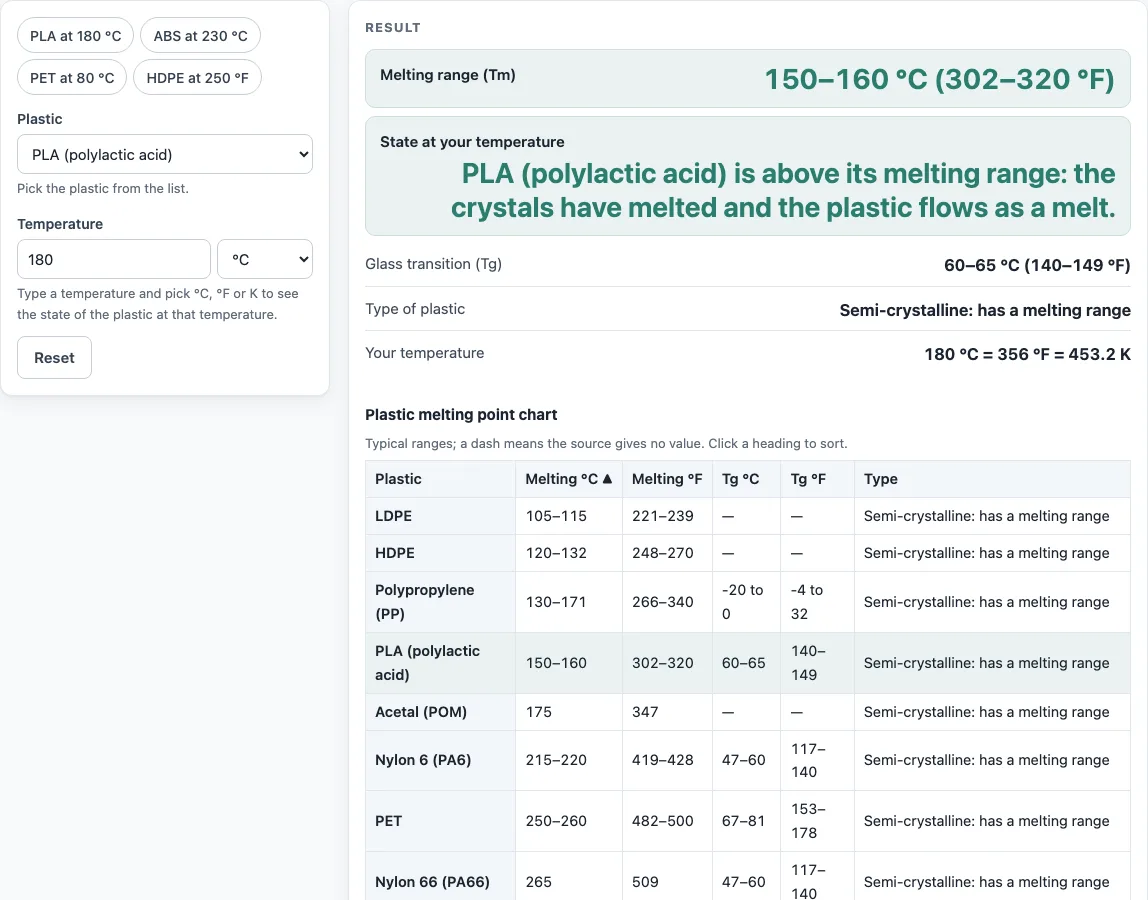
- Read the results panel. It shows the Melting range (Tm), the Glass transition (Tg), the Type of plastic and the State at your temperature. It also converts your temperature into °C, °F and K under Your temperature.
- If you want a quick example, click one of the chips above the results, such as PLA at 180 °C, ABS at 230 °C, PET at 80 °C or HDPE at 250 °F. Each chip fills in both fields for you.
- To compare plastics, scroll down to the full chart and click a heading to sort the rows. Use the °C or °F column, whichever suits your work.
- Open ‘How it was calculated’ to see your temperature converted to °C, °F and K and the comparison with Tg and Tm. ‘Copy link’ keeps your inputs in the address, and ‘Print / save result’ prints the result.
Change the temperature or the plastic at any time, and the results update straight away. The chips are the fastest way to see how the tool works before you enter your own values.
At what temperature does plastic melt?
Most plastics do not melt at a single temperature. Semi-crystalline plastics, such as PLA (150–160 °C), HDPE (120–132 °C) and nylon 6 (215–220 °C), melt across a range because their crystals break down over several degrees. Amorphous plastics, such as ABS and polystyrene, soften gradually instead.
The tool sorts each state by comparing your temperature with two values: the glass transition (Tg) and the melting range (Tm). Below Tg, the plastic is glassy and hard. Between Tg and Tm, it is soft but still held together by its crystals. Inside the melting range, it is melting. Above Tm, it is molten.
What is the difference between melting point and glass transition?
The glass transition (Tg) is the temperature at which an amorphous polymer changes from hard and glassy to soft and rubbery. Melting (Tm) is the temperature at which the crystalline part of a plastic melts and flows as a liquid. The two are different events, and a plastic can have both.
For example, PET has a Tg of 67–81 °C and melts at 250–260 °C. Polypropylene’s Tg is around −20 °C for atactic grades and 0 °C for isotactic grades, but it melts at 130–171 °C. A plastic can be rubbery well before it melts, so Tg tells you when it stops being rigid.
Do amorphous plastics have a melting point?
No, not a sharp one. Amorphous plastics, including ABS, polycarbonate, PVC, polystyrene and PMMA, have no defined melting point. They soften around their glass transition and become easier to flow as they get hotter. Wikipedia gives ABS no definite melting point, with a Tg of about 105 °C, and polycarbonate starts to flow above about 155 °C.
Ranges also shift with the specific material. Grade, molecular weight, crystallinity, fillers and plasticizers (common in PVC) all change the numbers. Moisture lowers the glass transition of nylon. The test method matters too, so check your material’s datasheet when precision counts.
Sources
Checked October 2026:
- Wikipedia articles for each polymer: Polylactic acid, ABS, Polycarbonate, Polypropylene, Polyethylene and HDPE, PVC, PET, Polystyrene, PMMA, PTFE, Polyoxymethylene, Nylon 6 and Nylon: melting points and glass transitions as printed in each infobox or properties section
- Wikipedia, Glass transition (table of polymer Tg values, such as polyamide 47–60 °C and PLA 60–65 °C)
Worked examples
| Input | Result |
|---|---|
| PLA (polylactic acid) at 180 °C | PLA (polylactic acid) is above its melting range: the crystals have melted and the plastic flows as a melt. |
| ABS at 230 °F | ABS is above its glass transition: soft and rubbery. It has no sharp melting point and flows more easily as it gets hotter. |
| HDPE at 100 °C | HDPE is below its melting range: still solid. |
| PTFE (Teflon) at 500 K | PTFE (Teflon) is above its glass transition and below its melting range: the amorphous part is soft and rubbery, while the crystals still hold the shape. |
Calculated by the tool above with these values.
Frequently asked questions
Why are 3D printer nozzle temperatures higher than the melting points on this chart?
A plastic has to flow quickly through a nozzle, so printing needs to run above the melting range. The chart does not give print temperatures. Use the datasheet for your filament.
Which plastics have no sharp melting point?
ABS, polycarbonate, PVC, polystyrene and acrylic (PMMA) are amorphous, so the chart gives no melting range for them. Only their glass transition is listed, and the tool tells you whether your temperature is below, inside or above it.
Is the Tg of nylon fixed?
No. The chart lists the polyamide family range of 47–60 °C, but moisture acts as a plasticizer and lowers the glass transition of nylon, so a wet part softens at a lower temperature than a dry one.
What does a dash in the chart mean?
A dash means the source used for the chart gives no value for that property. It does not mean the plastic has no melting point or glass transition.
What happens if I enter a temperature above 400 °C?
The tool shows a warning, because most polymers decompose before they reach that temperature. Results above 400 °C should not be treated as a melting behaviour.
Why do my results differ from another website?
Different sources report different grades and test methods, so the same plastic can show a different range. The tool uses the values printed in Wikipedia’s polymer articles.
Related tools
- Plastic density chart: Use it when you need to compare how dense different plastics are, for example to estimate weight.
- Shore hardness chart: Use it to compare how firm or flexible a material is on the Shore scale.
- Foam density chart: Use it when you are working with foamed materials rather than solid plastic.
- Recycling symbols chart: Use it to identify a plastic from the recycling code printed on a product.
- Plastic weight calculator: Use it to estimate the weight of a plastic part from its size and material.
- Filament calculator: Use it to work out how much filament a 3D print will need.