Plastic Density Chart (Density of HDPE, PP, PLA)
Typical densities of common plastics in every unit, with specific gravity and whether each one floats in water.
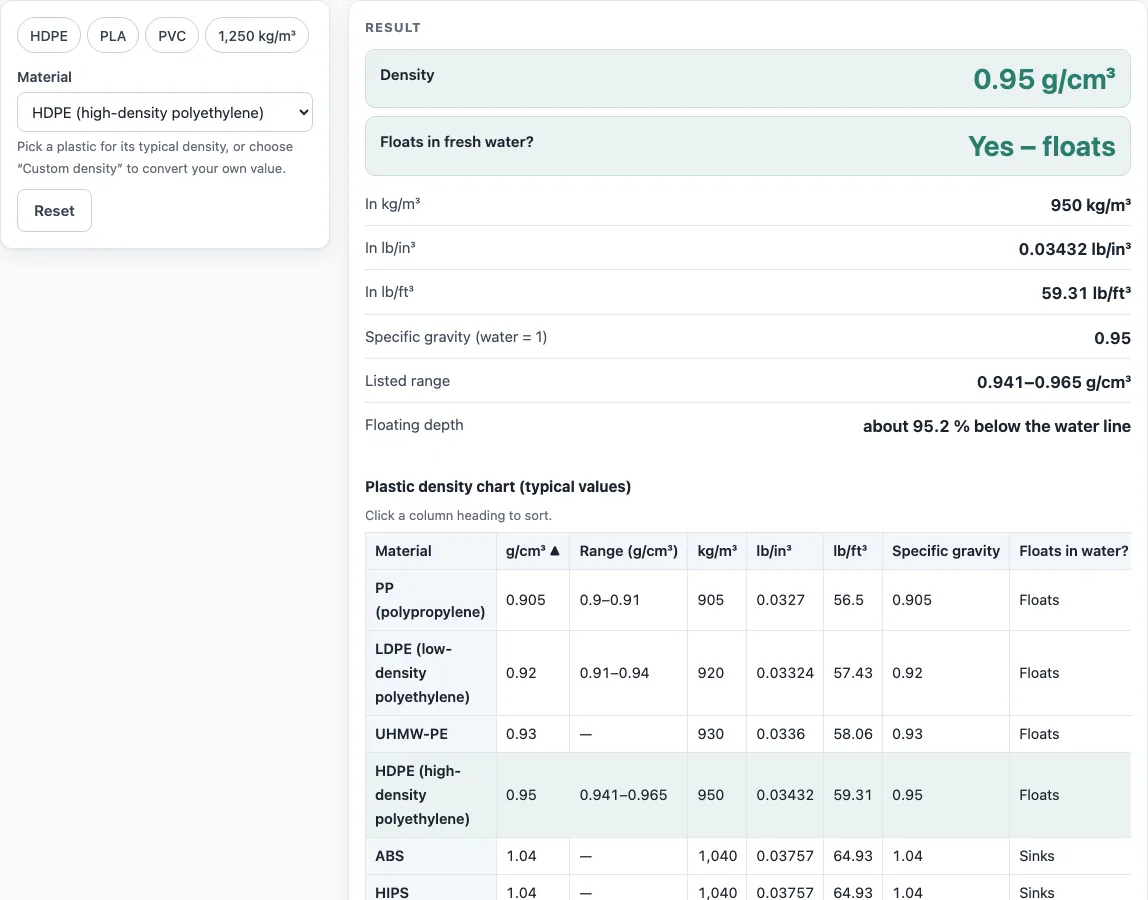
How to use the Plastic Density Chart
- Find HDPE in the chart table, or click a column heading to sort the table.
- To check a specific plastic, pick it from the list of materials.
- To check your own value, type a number and choose its unit: g/cm³, kg/m³, lb/in³, lb/ft³ or specific gravity.
- Read the converted value in every unit.
- Check the listed range and the float result. For a custom value, read the closest listed plastic.
- Open “How it was calculated” to see the formula and each step with your numbers.
Results update as you type, so you do not need a button to refresh them. Copy result copies the result lines with a link. Copy link copies the page address, which stores every input (?s=…), so opening it later restores the same calculation. Print / save as PDF prints the inputs, results, calculation steps and the date.
Click any column heading of the chart to sort it, for example by density to see which plastics float.
To check a plastic you do not know, type its density from the datasheet as a custom value; the tool converts it, says whether it floats and names the closest plastic on the list.
What is the density of HDPE?
HDPE has a typical density of 0.95 g/cm³, which equals 950 kg/m³ or 59.3 lb/ft³. Its listed range is 0.941 to 0.965 g/cm³, and the exact value depends on the grade, so use the datasheet for the grade you buy.
Density is mass divided by volume. HDPE is commonly classed by its density: polyethylene of about 0.941–0.965 g/cm³ is called high-density, while LDPE falls at about 0.910–0.940 g/cm³. To convert units, use these exact factors: 1 g/cm³ = 1,000 kg/m³ = 0.036127 lb/in³ = 62.428 lb/ft³. For example, 0.95 × 62.428 = 59.31 lb/ft³. Specific gravity is numerically equal to g/cm³ because water is 1, so a value of 0.95 specific gravity is also 0.95 g/cm³.
Which plastics float in water?
A plastic floats in fresh water when its density is below 0.998 g/cm³, the density of water. Polyolefins such as polyethylene and polypropylene float, while PLA, PET, PVC and PTFE sink.
The rule is a simple comparison. An object floats when it is less dense than the liquid it sits in. HDPE at 0.95 g/cm³ floats, and so do LDPE at 0.92, UHMW-PE at 0.93 and PP at 0.905. PLA at 1.24 g/cm³ sinks, and so does PTFE at 2.2 g/cm³. Most of the other listed plastics, including ABS, PS, PC and PMMA, are above 1.0 g/cm³ and sink too.
This difference is used in recycling. Polyolefins float in water, which lets them be separated from heavier plastics such as PET and PVC. A density check like this only tells you whether a plastic floats, so a float test on a mixed pile of pieces is not a way to identify the exact material.
What is the density of nylon, polycarbonate and acetal?
Typical values are nylon (PA6) 1.13 g/cm³, polycarbonate 1.20 g/cm³ and acetal (POM) 1.41 g/cm³. All three sink in water. Filled grades, for example glass-filled nylon, are heavier; take their density from the datasheet and enter it as a custom value.
Sources
Checked October 2026:
- Typical densities checked against data sheets: Ultimaker PLA/ABS/PC/CPE/TPU, NatureWorks Ingeo 3D850, Eastman Eastar 6763 (PETG), INEOS Terluran GP-35 (ABS), BASF Ultramid B27 (PA6), Plastics International data sheets (HIPS, PTFE, HDPE, PET)
- Europlas, LDPE vs HDPE for the 0.910–0.940 and 0.941–0.965 g/cm³ ranges; Wikipedia, Polypropylene
- NIST SP 811 and NIST Handbook 44 appendix C for unit conversions (1 in = 25.4 mm, 1 US gal = 231 in³)
For estimation; verify critical designs against the applicable standard.
Worked examples
| Input | Result |
|---|---|
| HDPE (high-density polyethylene) | 0.95 g/cm³ = 950 kg/m³ = 0.03432 lb/in³ = 59.31 lb/ft³; Yes – floats |
| PLA (polylactic acid) | 1.24 g/cm³ = 1,240 kg/m³ = 0.0448 lb/in³ = 77.41 lb/ft³; No – sinks |
| PP (polypropylene) | 0.905 g/cm³ = 905 kg/m³ = 0.0327 lb/in³ = 56.5 lb/ft³; Yes – floats |
| PTFE | 2.2 g/cm³ = 2,200 kg/m³ = 0.07948 lb/in³ = 137.3 lb/ft³; No – sinks |
| 1250 kg/m³ | 1.25 g/cm³ = 1,250 kg/m³ = 0.04516 lb/in³ = 78.03 lb/ft³; No – sinks |
Calculated by the tool above with these values.
Frequently asked questions
What is the density of polypropylene?
The typical density of polypropylene (PP) is 0.905 g/cm³, with a range of 0.90–0.91 g/cm³. At that density, PP floats in fresh water.
What is the density of PLA?
PLA (polylactic acid) has a typical density of 1.24 g/cm³, which is 1,240 kg/m³ or 77.41 lb/ft³. Because it is above 0.998 g/cm³, PLA sinks.
What is the density of LDPE?
LDPE has a typical density of 0.92 g/cm³, with a range of 0.910–0.940 g/cm³. It is lighter than HDPE and also floats.
What is the density of acrylic (PMMA)?
Acrylic, also called PMMA, has a typical density of 1.18 g/cm³. It is denser than water, so it sinks.
What is the density of UHMW polyethylene?
UHMW-PE has a typical density of 0.93 g/cm³, so it floats. Its exact value can vary by grade, so check the supplier’s datasheet for the grade you plan to use.
Is PEEK or polydimethylsiloxane on this chart?
No. The chart lists 19 plastics, and neither PEEK nor polydimethylsiloxane is among them. To check either one, type its density from a datasheet as a custom value, and the tool will convert it and show the closest listed plastic.
What is the density of PET and PVC?
PET is typically 1.38 g/cm³ and rigid PVC 1.40 g/cm³ (range 1.30–1.45); both sink in water.
How do I convert g/cm³ to lb/ft³?
Multiply by 62.428. HDPE at 0.95 g/cm³ is 59.3 lb/ft³; PTFE at 2.2 g/cm³ is 137.3 lb/ft³.
Related tools
- Plastic weight calculator: Use it when you know the volume of a part and need its weight from the density.
- Recycling symbols chart: Use it to identify a plastic from the number or symbol on its label.
- Filament calculator: Use it to estimate how much 3D printing filament a print will use.
- Mil to mm converter: Use it to convert film or sheet thickness between mils and millimetres.
- Plexiglass thickness chart: use it for acrylic sheet sizes and the weight of a sheet.
- All calculators: Use it to browse every calculator on the site.
- Foam density chart: use it for foam densities in lb/ft³ and kg/m³ and the ASTM C578 EPS and XPS types.
- Plastic melting point chart: use it for the melting range and glass transition of common plastics.