Nitrile O-Ring vs Viton O-Ring Material Chart
Pick an O-ring material and a fluid to see if it is resistant, not resistant or not stated, with each material's temperature range.
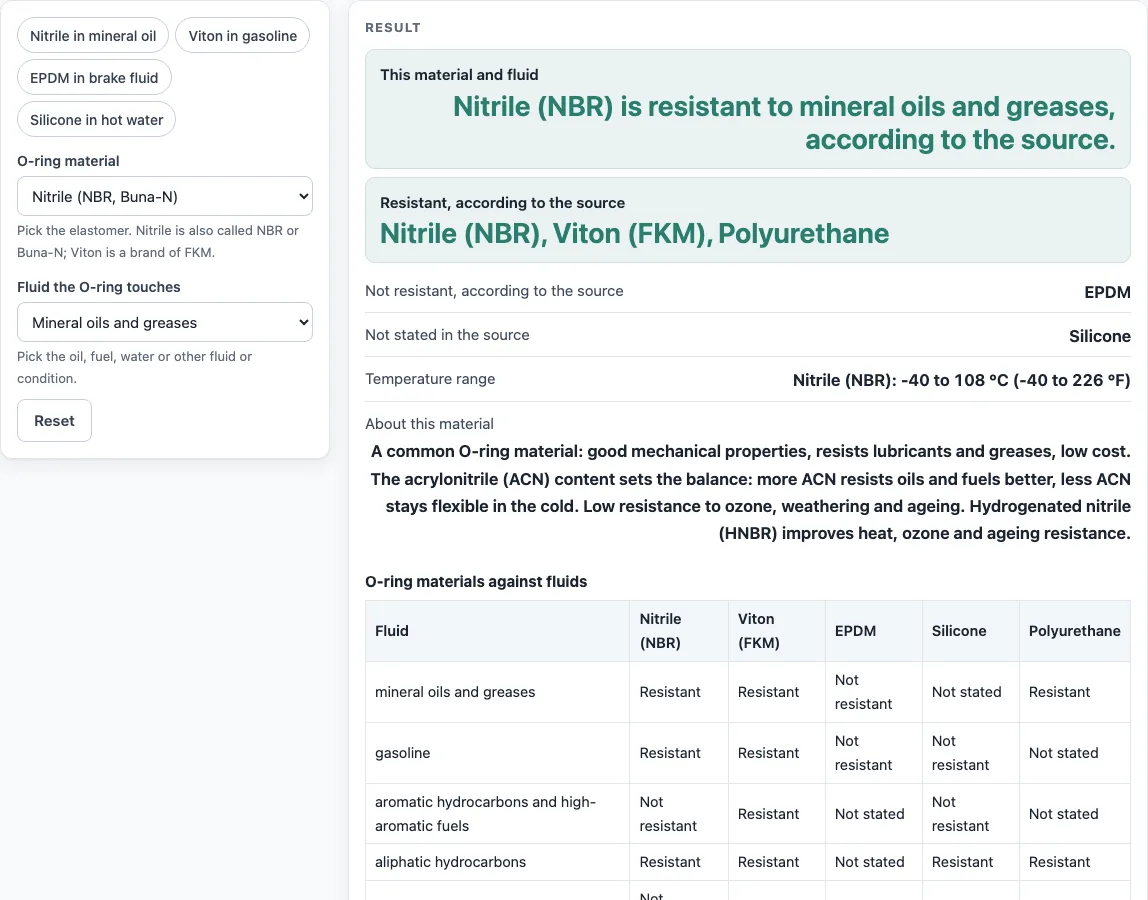
How to use the O-ring material chart
- Open the O-ring material dropdown and choose Nitrile NBR / Buna-N, Viton FKM, EPDM, Silicone or Polyurethane TPU.
- Open the Fluid the O-ring touches dropdown and choose one of the 15 fluids or conditions, such as mineral oils and greases, gasoline, water, hot water or glycol-based brake fluid.
- Read the result panel. It shows whether your material and fluid are resistant, not resistant or not stated. Below that, it lists which materials fall into each group for the fluid you picked.
- Check the temperature range shown in the result panel for your chosen material.
- Scroll down to the main table to compare all five materials against all 15 fluids at once. The second table gives the temperature range of each material.
- Read the About this material line for a short note on the material you picked, such as what sets nitrile’s oil resistance. The chips above the form load Nitrile in mineral oil, Viton in gasoline, EPDM in brake fluid and Silicone in hot water.
Once you have a result, Copy result copies the result lines with a link, so you can paste them into a message or note. Copy link stores your material and fluid in the address, so the same pairing opens again when you share the link. Print / save result prints the result panel or saves it as a file.
What is a nitrile O-ring used for?
Nitrile is a common O-ring material because of its good mechanical properties, its resistance to lubricants and greases, and its relatively low cost. The chart rates it as resistant to mineral oils and greases, and the O-ring article lists Buna-N for petroleum-base hydraulic oil. Nitrile is also listed as resistant to gasoline, so it appears in the gasoline group alongside Viton.
Nitrile’s oil and fuel resistance depends on its acrylonitrile content. More acrylonitrile gives better resistance to oil and fuel, but less flexibility at low temperatures. Nitrile has low resistance to ozone, weathering and ageing, so the chart rates it not resistant for ozone, weather and ageing.
What is the difference between Viton and nitrile (Buna-N) O-rings?
Viton is a trade name for fluoroelastomer, abbreviated FKM. Nitrile is also called NBR or Buna-N. The two materials are not interchangeable, and the fluid you use matters more than which one is “better” in general.
One difference is heat. Nitrile is stated to be stable from −40 to 108 °C (−40 to 226 °F). FKM is described as having very high heat resistance, but the source gives no figure, so the chart does not put a number on it. Both materials are resistant to gasoline. For hydraulic oils, the O-ring article lists Buna-N for petroleum-base oil and Viton for synthetic hydraulic oil.
When you compare a Viton O-ring with a Buna-N O-ring, start with your fluid and then check the temperature. Pick the material that is listed as resistant for that fluid, and make sure its temperature range covers your working conditions.
Sources
Checked October 2026:
- Wikipedia, O-ring: Materials and Chemical compatibility sections
- Wikipedia, Nitrile rubber: temperature range, oil and acid resistance
- Wikipedia, EPDM rubber: service temperatures, ozone, steam and weather resistance
- Wikipedia, Silicone rubber: temperature range, ozone and ageing resistance
Worked examples
| Input | Result |
|---|---|
| Nitrile (NBR) with mineral oils and greases | Nitrile (NBR) is resistant to mineral oils and greases, according to the source. |
| Viton (FKM) with gasoline | Viton (FKM) is resistant to gasoline, according to the source. |
| EPDM with glycol-based brake fluid | EPDM is resistant to glycol-based brake fluid, according to the source. |
| Silicone with steam | Silicone is not resistant to steam, according to the source. |
Calculated by the tool above with these values.
Frequently asked questions
What temperature can a nitrile O-ring take?
Nitrile is stated to be stable from −40 to 108 °C (−40 to 226 °F). In water, the source sets the limit at about 80 °C, which is lower than the general range. Check the water temperature before you choose nitrile for a hot water line.
Is a Viton O-ring good for gasoline?
Yes. The chart and the O-ring article both list Viton (FKM) as resistant to gasoline. Nitrile is also listed as resistant to gasoline, so both materials are valid choices for that fluid.
Which O-ring material is good for hot water and brake fluid?
For hot water, the chart rates EPDM and silicone as resistant, and Viton (FKM) as not resistant; the source gives silicone a water limit of 100 °C (212 °F). For glycol-based brake fluid, EPDM is rated resistant, while nitrile and Viton are rated not resistant.
What does “Not stated” mean?
It means the source the chart uses does not give a rating for that material and fluid. The tool never guesses, so “Not stated” is not the same as “not resistant.” Check the O-ring maker’s compatibility table or test the seal in your fluid.
Can I rely on this chart alone?
Not for a critical seal. Compound, cure system, temperature, pressure and fluid concentration all change real compatibility. Use the chart as a starting point, then confirm with your O-ring maker’s compatibility table or a test in your own fluid.
Related tools
- O-ring size chart — use it to find the dimensions of an O-ring once you have chosen a material.
- O-ring groove calculator — use it to work out the groove dimensions that hold your O-ring.
- Shore hardness chart — use it to compare the hardness ratings of elastomers and plastics.
- Plastic melting point chart — use it to check the melting point of a plastic part.
- Plastic density chart — use it to compare the density of common plastics.
- Trash bag size chart — use it to pick a trash bag that fits your bin.