O Ring Groove Size Chart and Gland Calculator
Pick an O-ring and see the recommended groove depth and width, then enter your own groove to check squeeze, gland fill and stretch.
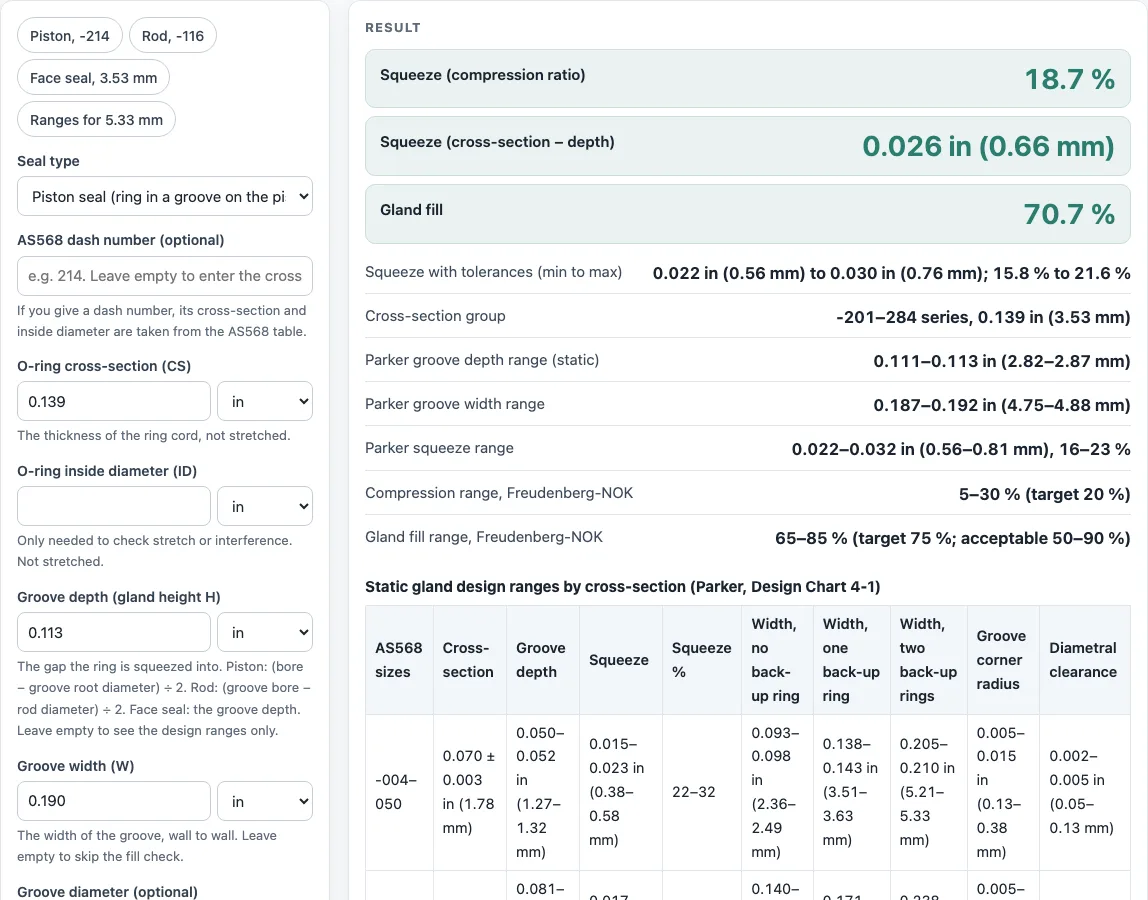
How to use the O-ring groove calculator
- Choose a ‘Seal type’: piston seal, rod seal, or face seal with pressure from outside or inside.
- Type an ‘AS568 dash number (optional)’, such as 214, to take the cross-section and inside diameter from the AS568 table. Without a dash number, type the ‘O-ring cross-section (CS)’ yourself, and the ‘O-ring inside diameter (ID)’ if you want a stretch check.
- Type the ‘Groove depth (gland height H)’ and ‘Groove width (W)’. Leave both empty to see only the design ranges for your cross-section.
- Optionally type a ‘Groove diameter (optional)’. It needs a dash number or an ID.
- Set ‘Back-up rings (for the groove width range)’ to none, one or two.
- To get minimum and maximum squeeze, open ‘More options’ and type a ‘Groove depth tolerance (±)’.
- Read the squeeze, gland fill, stretch or interference, the design ranges and any warnings. ‘How it was calculated’ shows each step with your numbers.
- Change one groove dimension at a time and watch how the squeeze and fill move back into range.
The example buttons ‘Piston, -214’, ‘Rod, -116’, ‘Face seal, 3.53 mm’ and ‘Ranges for 5.33 mm’ load sample inputs. ‘Copy result’, ‘Copy link’ (the link keeps all your inputs), ‘Print / save as PDF’ and ‘Reset’ sit beside the results.
O-ring groove sizing guide: what depth and width does an O-ring need?
Groove depth is the gap the ring is squeezed into, and groove width is the distance from wall to wall. For a piston seal, depth is (bore − groove root diameter) ÷ 2. For a rod seal, it is (groove bore − rod diameter) ÷ 2. For a face seal, it is the groove depth itself.
The ranges depend on cross-section and come from a seal maker’s design chart for static radial glands. For a 0.139 in (3.53 mm) ring, depth is 0.111–0.113 in (2.82–2.87 mm) and width is 0.187–0.192 in (4.75–4.88 mm) with no back-up ring. For a 0.210 in (5.33 mm) ring, depth is 0.170–0.173 in and width is 0.281–0.286 in.
How do I calculate O-ring squeeze (compression)?
Squeeze is cross-section minus groove depth, and compression is squeeze divided by cross-section. With 0.139 in and a 0.113 in groove, squeeze is 0.026 in (0.66 mm), which is 18.7%. A seal maker’s guide gives 5–30% for piston and rod seals (target 20%) and 10–35% for face seals (target 25%), with the minimum squeeze at least 0.005 in (0.1 mm).
What is gland fill, and how much stretch is too much?
Gland fill is the ring’s cross-sectional area divided by the groove area, π × (CS ÷ 2)² ÷ (depth × width). The target is 65–85%, and 50–90% is called acceptable. Stretch is (groove diameter − ID) ÷ ID and should stay between 0 and 5%. Rod seals are checked for interference instead, within 0–2%, and face seals with pressure from inside within 0–3%.
Do back-up rings change the groove width?
Yes. For the 0.070 in series the width is 0.093–0.098 in with no back-up ring, 0.138–0.143 in with one and 0.205–0.210 in with two.
What are the limits of this calculator?
It covers static seals only, and the figures assume a pressure below 1500 psi. Face seals are not compared with the radial depth and width ranges, because those describe radial glands. Temperature, swell and tolerance stack-up are not modelled, so test the real hardware.
Sources
Checked October 2026:
- Parker O-Ring Handbook (ORD 5700), Design Chart 4-1, Industrial Static Seal Glands: groove depth, squeeze, groove width with and without back-up rings, corner radius and diametral clearance for each AS568 cross-section (a copy of Parker’s chart hosted by a distributor)
- Freudenberg-NOK O-Ring Design Quick Reference Guide, AS568 sizes: squeeze, compression ratio, gland fill and stretch formulas, the recommended ranges and the reduced cross-section table (static seals under 1500 psi)
- Marco Rubber, O-Ring Gland General Design Considerations: the rule that cross-section reduction is about half the ID stretch, used when the cross-section is not an AS568 series
- Simrit, AS568 Dimensions: ID, cross-section and tolerance of each dash number
Worked examples
| Input | Result |
|---|---|
| piston, 0.139 in cross-section, depth 0.113 in, width 0.190 in | compression 18.7 %; fill 70.7 % |
| piston, -214, depth 0.113 in, width 0.190 in, groove diameter 1.004 in | compression 17.5 %; fill 68.6 %; stretch 2.0 % |
| rod, -116, depth 0.083 in, width 0.145 in | compression 19.4 %; fill 69.2 % |
| faceExt, 3.53 mm cross-section, depth 2.7 mm, width 4.8 mm | compression 23.5 %; fill 75.5 % |
| piston, 5.33 mm cross-section | depth 0.170–0.173 in (4.32–4.39 mm); width 0.281–0.286 in (7.14–7.26 mm) |
Calculated by the tool above with these values.
Frequently asked questions
What are the groove dimensions for a -214 (or any AS568 size) O-ring?
Type 214 in ‘AS568 dash number (optional)’. The -214 has a 0.139 in cross-section, so the static depth is 0.111–0.113 in and the width is 0.187–0.192 in with no back-up ring. The ‘Piston, -214’ example uses a depth of 0.113 in, a width of 0.190 in and a groove diameter of 1.004 in, and gives 17.5% compression, 68.6% fill and no warnings.
What are metric O ring groove dimensions (mm)?
Switch the unit boxes to mm and the results show both units. The ranges are the inch design values converted to mm, not a separate metric standard. For 5.33 mm the depth is 4.32–4.39 mm and the width is 7.14–7.26 mm with no back-up ring.
What if my cross-section is not an AS568 size?
The design ranges appear only if the cross-section is within tolerance of 0.070, 0.103, 0.139, 0.210 or 0.275 in, or if you give a dash number in one of those series. Otherwise the page warns and checks only the squeeze, fill and stretch ranges.
Does a result with no warnings guarantee a good seal?
No. The page is a design check against published ranges. Seal material, temperature, pressure and machining tolerances all matter, so confirm critical grooves with the seal maker’s data and a test.
Is the calculator free, and is anything I type uploaded?
Yes, the calculator is free, runs in your browser and needs no sign-up. Nothing you type is uploaded.
Related tools
- O ring size chart: use it to look up the AS568 dash number, cross-section and inside diameter before you enter them here.
- Shore hardness chart: use it to compare hardness values when choosing an elastomer for the seal.
- Mil thickness chart: use it when you need thickness values expressed in mils.
- Plastic density chart: use it to look up density values for plastic materials.
- Heat shrink tubing size chart: use it to choose tubing sizes by diameter before shrinking.
- All calculators: use it to browse every calculator on this site.