Mil to mm Converter and Thickness Chart
Convert film and sheet thickness between mil, inches, millimetres, microns and gauge, or read it off the chart.
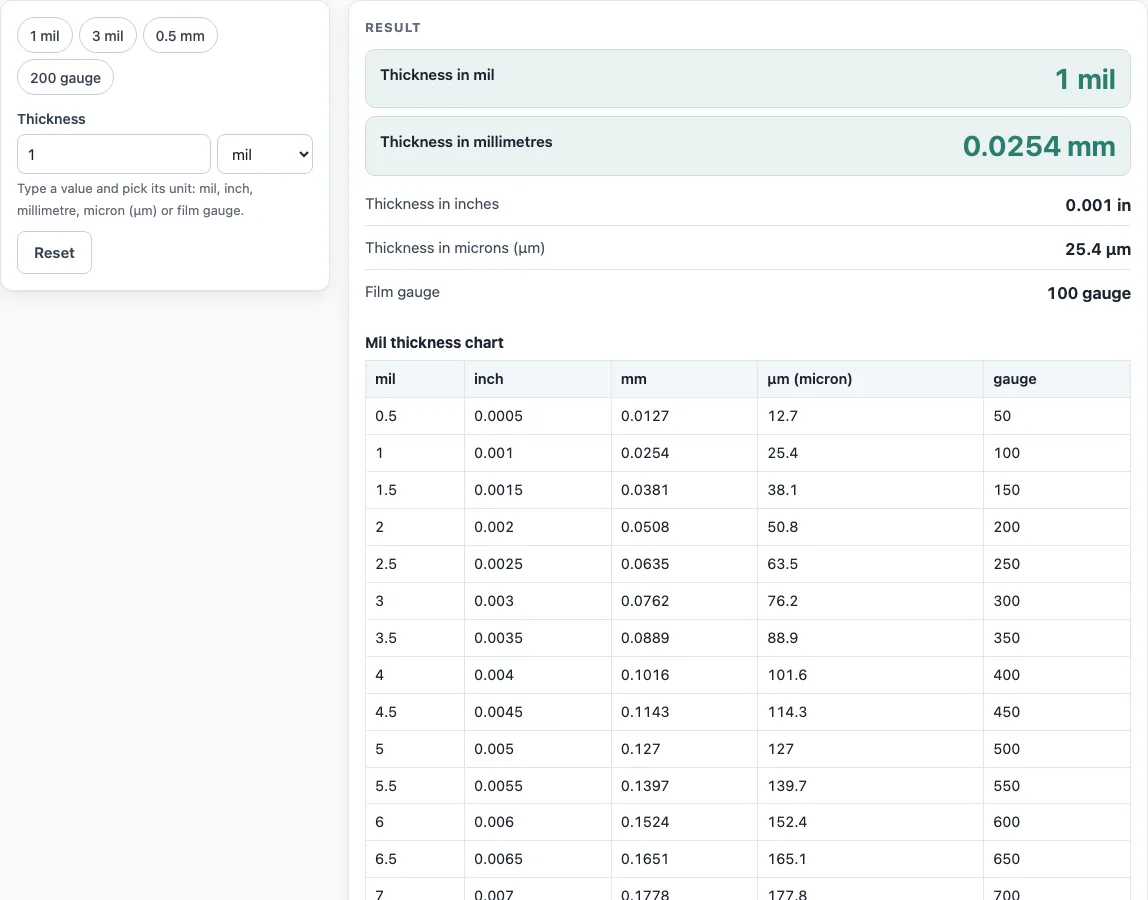
How to use the mil thickness chart
- Click the input box at the top of the tool and type a thickness. You can enter it in mil, inches, mm, µm (microns) or gauge.
- Check the results. All five values appear as you type, so there is no button to press.
- Open “How it was calculated” to see the formula and each step with your numbers.
- For a list of common values, use the mil to in, mm, µm and gauge chart. It covers 0.5 to 10 mil in 0.5 steps, then 12, 15, 20, 30, 40, 60, 80 and 100 mil.
- For millimetre thicknesses, use the mm to mil chart. It covers 0.1, 0.2, 0.5, 1, 1.5, 2 and 3 mm.
- If you enter a value far thicker than film or sheet, the tool warns you that it is normally quoted in mil and reminds you that a mil is not a millimetre.
To keep your results, use the buttons below the results:
- Copy result copies the result lines with a link.
- Copy link copies the page address. It stores every input (the ?s= part), so opening it later restores the same calculation.
- Print / save as PDF prints the inputs, results, calculation steps and the date.
Everything runs in your browser, nothing you type is uploaded, and the tool works on a phone. You can use the results in commercial work such as quotes, price lists, job sheets and reports without attribution.
How do you convert mil to mm?
To convert mil to mm, multiply the number of mil by 0.0254. A mil is a thousandth of an inch, and 1 inch is exactly 25.4 mm, so 1 mil = 0.001 × 25.4 = 0.0254 mm.
For example, 3 mil × 0.0254 = 0.0762 mm, 10 mil × 0.0254 = 0.254 mm, and 20 mil × 0.0254 = 0.508 mm. To get microns, multiply mil by 25.4 instead, so 3 mil = 76.2 µm.
A mil is not a millimetre. A mil is much smaller, because 1 mm is about 39.37 mil. A film rated at 1 mil is 0.0254 mm thick, not 1 mm.
How do you convert mm to mil?
To convert mm to mil, divide the millimetres by 0.0254. This is the same as multiplying by 39.37.
For example, 0.5 mm ÷ 0.0254 = 19.69 mil, 1 mm ≈ 39.37 mil, and 1.5 mm ≈ 59.06 mil. For microns, divide by 25.4, so 25 µm ≈ 0.984 mil.
For plastic film, gauge is mil × 100, so 1 mil = 100 gauge and 2 mil = 200 gauge. Convert mm to gauge by dividing mm by 0.0254 and then multiplying by 100.
How thick is 1 mil, 4 mil, 6 mil and 10 mil?
Multiply by 0.0254 for mm or by 25.4 for microns: 1 mil = 0.0254 mm (25.4 µm), 4 mil = 0.1016 mm, 6 mil = 0.1524 mm, 10 mil = 0.254 mm. Film and bag makers often quote the same thickness as gauge (mil × 100), so 6 mil polyethylene sheeting is 600 gauge.
Is mil the same as millimetre?
No. “Mil” is short for a thousandth (milli-) of an inch, not a millimetre. 1 mm is about 39.37 mil, so a 1 mm sheet is almost 40 mil thick. Mixing the two up gives a thickness wrong by a factor of 39.37.
How do you read a film thickness chart?
Each row of the chart is one thickness in mil, followed by the same thickness in inches, millimetres, microns and gauge. To find a metric thickness, look in the mm column for the nearest row, or type the value into the converter for an exact answer.
Sources
Checked October 2026:
- Wikipedia, Thousandth of an inch: 1 mil = 0.001 in = 25.4 µm
- Industrial Packaging, gauge vs mil: 100 gauge = 1 mil
For estimation; verify critical designs against the applicable standard.
Worked examples
| Input | Result |
|---|---|
| 1 mil | 1 mil = 0.001 in = 0.0254 mm = 25.4 µm = 100 gauge |
| 3 mil | 3 mil = 0.003 in = 0.0762 mm = 76.2 µm = 300 gauge |
| 0.5 mm | 19.69 mil = 0.01969 in = 0.5 mm = 500 µm = 1,969 gauge |
| 25 µm | 0.9843 mil = 0.0009843 in = 0.025 mm = 25 µm = 98.43 gauge |
| 200 gauge | 2 mil = 0.002 in = 0.0508 mm = 50.8 µm = 200 gauge |
Calculated by the tool above with these values.
Frequently asked questions
How many mm is 1 mil?
1 mil is 0.0254 mm, which is exactly 25.4 µm. It is a thousandth of an inch, so it is far thinner than 1 mm.
How thick is 10 mil?
10 mil is 0.01 inch, or 0.254 mm (254 µm). That is about a quarter of a millimetre.
How thick is 20 mil?
20 mil is 0.02 inch, or 0.508 mm (508 µm). That is just over half a millimetre.
What is the difference between mil and gauge?
A mil is a thousandth of an inch and works for any material. Gauge is a unit used mainly for plastic film, where 1 mil = 100 gauge, so 200 gauge = 2 mil = 0.0508 mm.
How thick is 5 mil in mm?
5 mil is 0.127 mm, or 127 µm. Multiply 5 by 0.0254 to get the result.
How do I convert micron to mil?
Divide microns by 25.4: 50 µm ≈ 1.97 mil and 100 µm ≈ 3.94 mil. In machining, a thousandth of an inch is also called a thou, which is exactly the same as 1 mil.
How thick is 6 mil plastic in mm?
6 mil is 0.1524 mm (152.4 µm), or 600 gauge.
How thick is a 2 mil trash bag?
2 mil is 0.0508 mm (50.8 µm), or 200 gauge. Heavier bags, such as contractor bags, are thicker (3 mil is 0.0762 mm); type the thickness on the box to see it in mm and microns.
Related tools
- Plastic weight calculator: use it when you need the weight of a plastic sheet or film, not just its thickness.
- Trash bag size chart: use it to compare bag sizes when you are choosing bags by thickness.
- Epoxy coverage calculator: use it to work out how much epoxy you need for a coating at a set thickness.
- Plastic density chart: use it to look up density values when you convert between thickness and weight.
- Heat shrink tubing size chart: use it to find tubing sizes for a wire or cable.
- Shore hardness chart: use it to compare Shore A, D and 00 hardness readings.
- All calculators: use it to browse every calculator on the site.