Foam Density Chart: EPS, XPS, Spray and Memory Foam
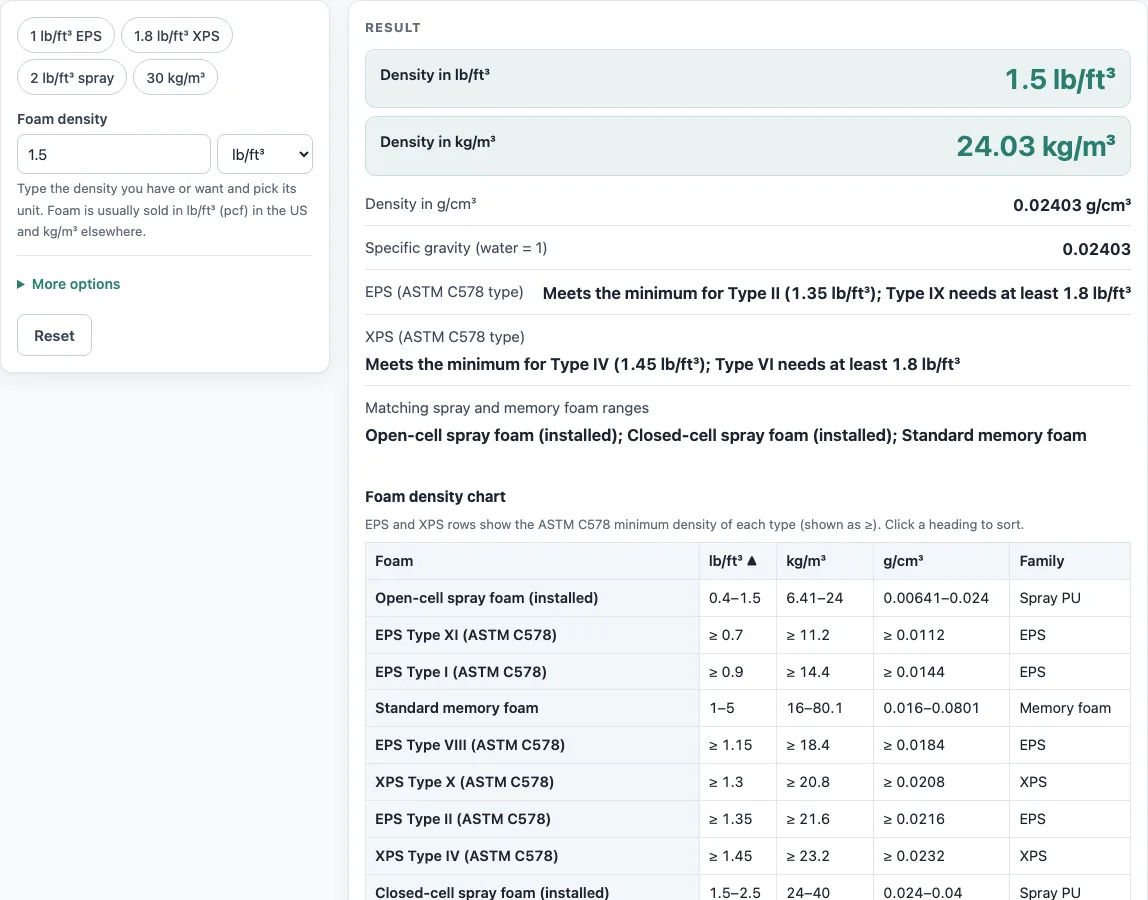
Type a foam density in lb/ft³, kg/m³ or g/cm³ to convert it and see which foam types it matches. The full chart is below.
This free foam density chart converts a foam’s density between lb/ft³, kg/m³ and g/cm³, and shows where that value sits among insulation, spray and memory foams. It runs in your browser with no sign-up, and nothing you enter is sent anywhere.
Foam density tells you how much a set volume of foam weighs. It helps when you are comparing insulation products, checking a spec, or estimating how heavy a foam block will be. Sources quote density in different units, so a quick conversion prevents mistakes. You can also enter a block’s length, width and thickness to get its volume and weight. The results are estimates based on published minimums and typical ranges, not a certified test.
How to use the Foam density chart
- Type your foam’s density into the Foam density box.
- Pick the unit from the list: lb/ft³, kg/m³ or g/cm³. If you are unsure, use a chip such as 1.8 lb/ft³ XPS, 1 lb/ft³ EPS, 2 lb/ft³ spray or 30 kg/m³ to load a common value.
- Read the density in all three units under Density in lb/ft³, Density in kg/m³ and Density in g/cm³.
- Check Specific gravity (water = 1) if you need a value relative to water.
- Look at EPS (ASTM C578 type) and XPS (ASTM C578 type) to see which foam types your density meets.
- Look at Matching spray and memory foam ranges to see where your value falls.
- For a weight, open More options and fill in Block length, Block width and Block thickness, choosing a unit for each. Block volume and Block weight appear only when all three sizes are filled.
- Click any column heading in the chart below the result to sort the list of foams, for example by density from lightest to heaviest.
The ‘How it was calculated’ list under the result shows the conversion with your numbers, and ‘Copy link’ keeps your inputs in the address so you can share or reopen a result. ‘Print / save result’ prints the inputs, results and steps.
Density is mass per unit volume, so it is the weight of a material divided by the space it takes up. Foam is mostly air inside a solid frame, so small changes in density make a noticeable difference in weight.
What is the density of EPS foam?
EPS, or expanded polystyrene, is molded foam. Under ASTM C578, the US standard for rigid cellular polystyrene thermal insulation, the EPS types have minimum densities from 0.70 lb/ft³ (Type XI) to 2.85 lb/ft³ (Type XV). That is about 11 to 46 kg/m³. Density is only one requirement of each type, since compressive strength and other properties also apply.
What is the density of XPS foam?
XPS, or extruded polystyrene, is the smooth-skinned board used under slabs and on walls. The ASTM C578 minimum densities of the XPS types run from 1.30 lb/ft³ (Type X) through 1.45 (Type IV), 1.80 (Type VI) and 2.20 (Type VII) to 3.00 lb/ft³ (Type V), which is about 21 to 48 kg/m³. Higher types also carry a higher compressive strength. A 1.8 lb/ft³ board meets the minimum for Type VI, but the type is only certain from the product label.
What is the density of spray foam?
Spray polyurethane foam comes in two main kinds. The California 2013 energy compliance reference gives a closed-cell installed nominal density of 1.5 to less than 2.5 lb/ft³, and an open-cell density of 0.4 to 1.5 lb/ft³. Open-cell foam is often called half-pound foam (about 0.5 lb/ft³), and closed-cell foam is often called two-pound foam (about 2 lb/ft³).
What density is memory foam?
Standard memory foam is 16 to 80 kg/m³, which is 1 to 5 lb/ft³. Topper pads and mattress comfort layers are usually 48 to 72 kg/m³, which is 3 to 4.5 lb/ft³. A value of 2 lb/ft³ falls inside the standard memory foam range.
How do I convert lb/ft³ to kg/m³?
Multiply the value in lb/ft³ by 16.0185 to get kg/m³. For example, 1.5 lb/ft³ × 16.0185 = 24.03 kg/m³. To go the other way, divide by 16.0185, so 30 kg/m³ ÷ 16.0185 = 1.873 lb/ft³. The factor comes from 1 lb = 453.59237 g and 1 ft³ = 28,316.8466 cm³, which gives 0.0160185 g/cm³, or 16.0185 kg/m³.
How much does a foam block weigh?
Block weight equals volume multiplied by density. First convert the dimensions to cubic feet, then multiply by the density in lb/ft³. For a 96 × 48 × 2 in block, the dimensions are 8 ft × 4 ft × 2 in, so the volume is 8 × 4 × (2/12) = 5.333 ft³. At 2 lb/ft³, the weight is 10.67 lb, or about 4.838 kg.
Sources
Checked October 2026:
- Owens Corning, FOAMULAR technical bulletin: ASTM C578 types and physical properties (minimum density of each EPS and XPS type, C578-23)
- Carpenter Co., typical properties of Carpenter expanded polystyrene (ASTM C578 EPS types with nominal 0.70 to 3.0 lb/ft³ and density ranges)
- California 2013 energy compliance reference, building envelope (spray foam installed nominal density: closed cell 1.5 to less than 2.5 pcf, open cell 0.4 to 1.5 pcf)
- Wikipedia, Memory foam (standard 16–80 kg/m³, toppers 48–72 kg/m³) and Spray foam (half-pound and two-pound foam)
- NIST SP 811, Appendix B (1 lb = 453.59237 g exactly; 1 ft³ = 28,316.8466 cm³)
Worked examples
| Input | Result |
|---|---|
| 1.5 lb/ft³ | 1.5 lb/ft³ = 24.03 kg/m³; Meets the minimum for Type II (1.35 lb/ft³); Type IX needs at least 1.8 lb/ft³ |
| 30 kg/m³ | 1.873 lb/ft³ = 30 kg/m³; Meets the minimum for Type IX (1.8 lb/ft³); Type XIV needs at least 2.4 lb/ft³ |
| 2 lb/ft³, block 96 × 48 × 2 in | 2 lb/ft³ = 32.04 kg/m³; Meets the minimum for Type IX (1.8 lb/ft³); Type XIV needs at least 2.4 lb/ft³; block 4.838 kg (10.67 lb) |
| 0.5 lb/ft³ | 0.5 lb/ft³ = 8.009 kg/m³; Below the lightest listed type (Type XI, 0.7 lb/ft³) |
Calculated by the tool above with these values.
Frequently asked questions
Is this foam density chart exact?
No. It gives an estimate from published minimums and typical ranges, not a certified test. A foam board’s actual density can be higher than the minimum for its type.
Does the chart cover upholstery or cushion foam?
No. The chart has no row for upholstery or cushion foam. Use the foam maker’s datasheet for those products.
What is pcf?
Pcf means pounds per cubic foot, the same unit as lb/ft³. A foam sold as 2 pcf has a density of 2 lb/ft³, which is about 32 kg/m³.
Does a higher density always mean a better foam?
No. Density is one requirement among several. ASTM C578 types also set other properties, such as compressive strength, so a foam must meet all of them.
Can I enter kg/m³ instead of lb/ft³?
Yes. Pick kg/m³ or g/cm³ from the unit list and the result shows all three units. Foam is quoted in lb/ft³ (pcf) in the US and in kg/m³ in most other places, and 1 lb/ft³ is 16.0185 kg/m³.
Do I need to fill in all three block sizes?
Only if you want a weight. Block volume and block weight appear only when block length, width and thickness are all filled in. You can select a unit for each size.
Related tools
- Plastic density chart: Use it to compare the density of common plastics with foam values.
- Plastic weight calculator: Use it to estimate the weight of a plastic part from its size.
- Shore hardness chart: Use it to compare how firm or soft a material is on the Shore scale.
- Plexiglass thickness chart: Use it to look up standard thicknesses for acrylic sheet.
- Plastic melting point chart: Use it to check the temperature at which common plastics melt.
- Recycling symbols chart: Use it to identify the recycling codes printed on plastic products.