Filament Calculator (Length and Weight)
Convert filament grams to metres and back for your material and diameter, and work out how much is left on a spool.
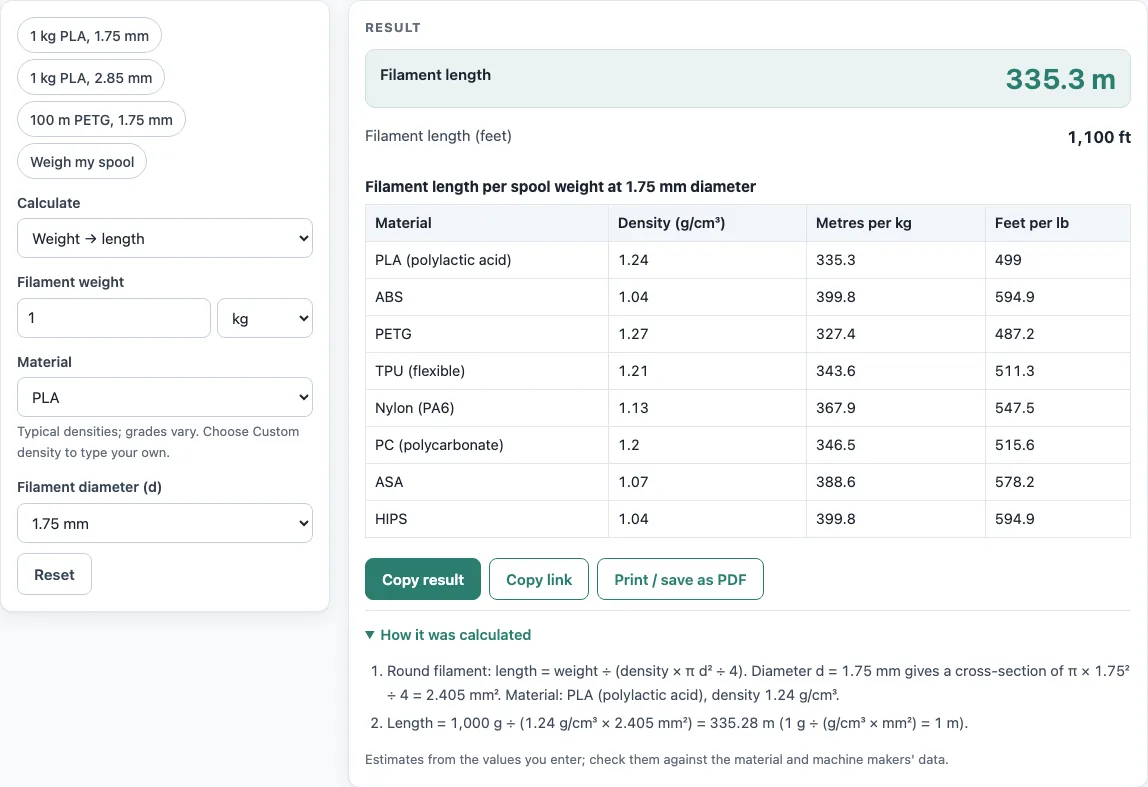
How to use the filament calculator
- Choose a mode: weight → length, length → weight, or spool remaining.
- Select your filament diameter: 1.75 mm or 2.85 mm, or enter a custom value (for example 3.00 mm).
- Pick a material from the list (PLA, PETG, ABS, TPU, nylon, PC, ASA, HIPS). If your material is not listed, enter a custom density in g/cm³.
- Enter your numbers. For weight → length, type the mass in grams. For length → weight, type the length in metres. For spool remaining, type the gross spool weight and the empty spool weight.
- For spool remaining, optionally enter the length or weight of your next print to see whether the filament is enough.
- Read the results. They show length in m and ft, weight in g, oz and lb, filament left on the spool, and enough or short by how much. A table lists metres per kg for each material at your diameter.
- Open “How it was calculated” to see the formula and each step with your own numbers.
Copy result copies the result lines with a link. Copy link copies the page address, which stores every input, so opening it later restores the same calculation. Print / save as PDF prints your inputs, results, calculation steps and the date.
How many meters are in 1 kg of filament?
About 335 m of 1.75 mm PLA is in 1 kg, which is roughly 1,100 ft. The exact figure depends on the material’s density and the filament’s diameter, so PETG and ABS give different lengths.
How do I convert filament grams to meters?
Divide the mass by the weight of one metre of filament. The formula is length = mass ÷ (density × π d² ÷ 4), where density is in g/cm³ and d is the diameter in cm. For example, 750 g of 1.75 mm PETG is about 246 m.
How much filament is left on my spool?
Subtract the empty spool weight from the gross weight to get the filament weight. Then convert that weight to metres using the same formula. A 650 g spool with a 250 g empty spool holds 400 g, which is about 134 m of 1.75 mm PLA.
Will I have enough filament for my print?
Compare the filament left on the spool with the length or weight your print needs. If the spool holds more, the tool says enough. If not, it shows how much you are short. Enter the print’s requirement in the next-print field to check this.
What is the density of PLA, PETG and ABS?
Typical densities are 1.24 g/cm³ for PLA, 1.27 g/cm³ for PETG and 1.04 g/cm³ for ABS. Density is the main reason one material gives more metres per kilogram than another. Use a custom density if your manufacturer gives a different value.
Diameter has a large effect too. 2.85 mm filament holds about 2.65 times less length per kilogram than 1.75 mm, because its cross-section is (2.85 ÷ 1.75)² larger.
To use the spool-remaining mode, weigh an empty spool of the same brand once, or check the maker’s figure for the empty spool weight.
How much does a metre of filament weigh?
One metre of 1.75 mm filament has a volume of π × 0.0875² × 100 ≈ 2.405 cm³, so it weighs about 2.98 g in PLA (1.24 g/cm³) and 2.50 g in ABS (1.04 g/cm³). Multiply by the metres your slicer reports to get grams, or use the length → weight mode.
Sources
Checked October 2026:
- Length = mass ÷ (density × π d² ÷ 4); diameters from the Prusament (1.75 mm) and Ultimaker (2.85 ± 0.10 mm) data sheets
- Typical densities checked against data sheets: Ultimaker PLA/ABS/PC/CPE/TPU, NatureWorks Ingeo 3D850, Eastman Eastar 6763 (PETG), INEOS Terluran GP-35 (ABS), BASF Ultramid B27 (PA6), Plastics International data sheets (HIPS, PTFE, HDPE, PET)
For estimation; verify critical designs against the applicable standard.
Worked examples
| Input | Result |
|---|---|
| 1 kg, PLA (polylactic acid), 1.75 mm | 335.3 m (1,100 ft) |
| 750 g, PETG, 1.75 mm | 245.5 m (805.5 ft) |
| 330 ft, ABS, 1.75 mm | 251.6 g (8.875 oz) |
| 50 m, TPU (flexible), 2.85 mm | 386 g (13.61 oz) |
| 650 − 250 g, PLA (polylactic acid), 1.75 mm | 400 g = 134.1 m left; Yes, the spool has enough |
Calculated by the tool above with these values.
Frequently asked questions
Why does 2.85 mm filament give less length per kilogram?
A 2.85 mm strand has a larger cross-section, so each metre weighs more. That means a kilogram covers about 2.65 times less length than 1.75 mm filament of the same material.
Can I use the results for quotes or job sheets?
Yes. Results may be used in commercial work, such as quotes, price lists, job sheets and reports, without attribution.
Does the calculator need an account or upload my data?
No. Everything runs in your browser. It is free, needs no sign-up, uploads nothing, and works on a phone.
How do I save a calculation for later?
Use Copy link. The page address stores every input, so opening that link restores the same calculation. To keep a paper or PDF record, use Print / save as PDF.
How many feet are in a kilogram of 1.75 mm PLA?
About 1,100 ft (335 m). Other materials differ because of density; the table under the result lists them all for your diameter.
Can I use a custom diameter?
Yes. Choose custom and enter the diameter you measured; small differences in diameter change the length noticeably because the area goes with the square of the diameter.
Does the calculator work for resin printers?
No. It is for filament (FDM) printers. Resin (SLA/MSLA) printers use liquid photopolymer measured by volume, which this tool does not cover.
Related tools
- 3D printing cost calculator — Use it to turn filament use into a price for a print job.
- 3D print time calculator — Use it to estimate how long a print will take.
- Esteps calculator — Use it to check and adjust your printer’s extruder steps per millimetre.
- Plastic density chart — Use it to compare density values across many plastics.
- Lithophane maker: use it to turn a photo into an STL and see how much filament it needs.
- All calculators — Use it to browse every calculator on the site.