Epoxy Resin Calculator
Enter the size and depth of your pour to get how much epoxy you need, split into resin and hardener by your mix ratio.
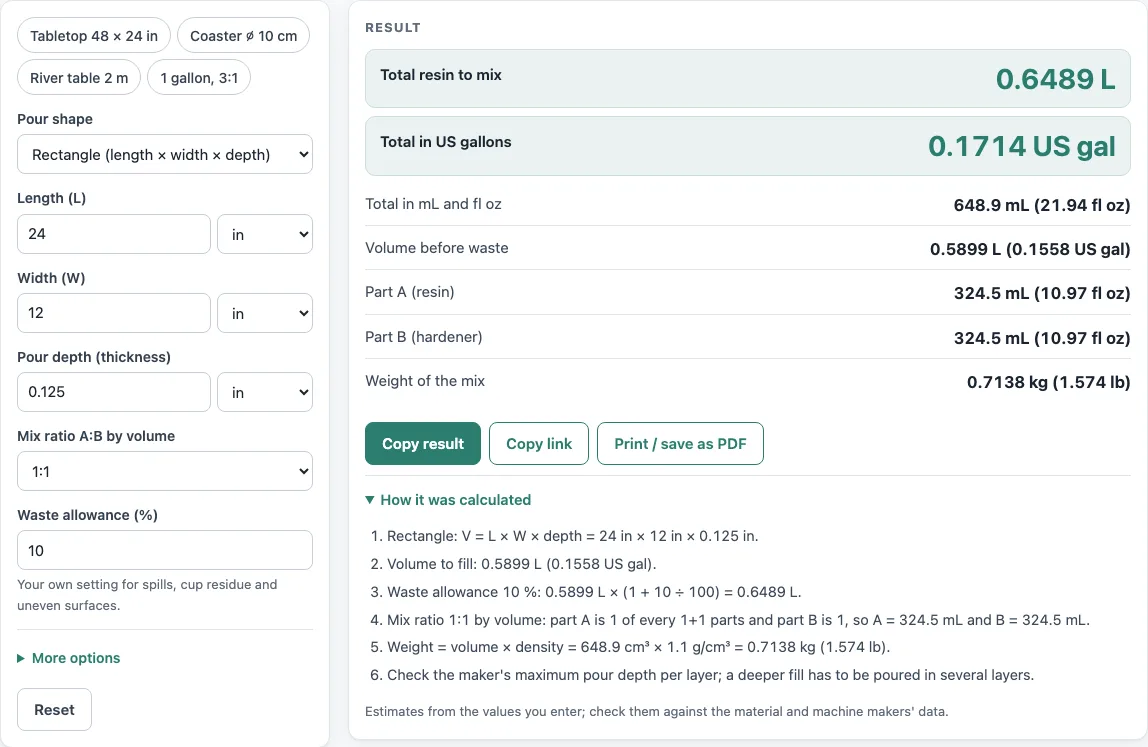
How to use the Epoxy resin calculator
- Choose a pour shape: rectangle, circle, river table, or a volume you type in directly.
- Enter the dimensions. A rectangle needs length, width and depth. A circle needs diameter and depth. A river table needs length, average river width and depth.
- Check the pour depth. For example, 24 in × 12 in × 0.125 in is a tabletop poured 1/8 in deep.
- Set the waste allowance. The default is 10 %, which covers mixing cups, drips and sanding. Change it if your job needs more or less.
- Pick the mix ratio: 1:1, 2:1, 3:1 or a custom A:B. Read the part A and part B volumes.
- Check the mixed density. The default is 1.10 g/cm³, a typical value. Replace it with the figure for your product to get the weight in kg and lb.
- Read the results. They update as you type. Open “How it was calculated” to see the formula and each step with your numbers.
When the result is right, use Copy result to copy the result lines with a link, or Copy link to copy the page address. The page address stores every input, so opening it later restores the same calculation. Print / save as PDF prints the inputs, results, calculation steps and the date.
How much epoxy resin do I need?
You need the volume of the space you want to fill, plus an allowance for waste. Volume is area multiplied by depth, so a 24 × 12 in tabletop poured 1/8 in deep needs 36 cubic inches before waste.
One US gallon is 231 cubic inches, so that tabletop needs about 0.156 gal of resin. Adding 10 % waste gives 0.1714 gal, or 648.9 mL (21.94 fl oz). The calculator does the same steps for any shape. A 100 cm × 50 cm pour at 3 mm gives 1,650 mL (55.79 fl oz), and a 30 cm round at 5 mm gives 388.8 mL (13.15 fl oz).
Keep the units consistent. Convert every measurement to the same unit before you multiply, or let the calculator convert the final result for you. Use the waste allowance to cover the resin you lose in cups and on brushes, rather than adding extra by guesswork.
How do I mix epoxy 2:1 or 1:1?
Mix epoxy at the ratio the resin maker gives, such as 1:1, 2:1 or 3:1 by volume. The first number is part A (resin) and the second is part B (hardener). So a 2:1 mix uses two parts resin to one part hardener.
The calculator splits your total volume into part A and part B for the ratio you choose. Measure each part separately, using the same unit, and stir for the time the maker specifies. Use the ratio on your product’s label; it differs between products.
Some resins are mixed by weight, not volume. Follow the maker’s instructions for which ratio applies. If the maker lists a weight ratio, use the weight figures from the maker rather than the volume split shown here.
Sources
Checked October 2026:
- Mixed epoxy density 1.10 g/cm³ (typical; cured unfilled systems 1.07–1.13: FlowCast TDS, 3M Scotchcast 1.12, Sika 1.13)
- Mix ratios by volume such as 1:1, 2:1 and 3:1 are product-specific (ArtResin FAQ, Composite Envisions 3:1 epoxy); use your label
- NIST SP 811 and NIST Handbook 44 appendix C for unit conversions (1 in = 25.4 mm, 1 US gal = 231 in³)
For estimation; verify critical designs against the applicable standard.
Worked examples
| Input | Result |
|---|---|
| 24 in × 12 in × 0.125 in | 648.9 mL (21.94 fl oz), 0.1714 US gal |
| 100 cm × 50 cm × 3 mm | 1,650 mL (55.79 fl oz), 0.4359 US gal |
| ⌀ 30 cm × 5 mm | 388.8 mL (13.15 fl oz), 0.1027 US gal |
| 2 m × 60 cm × 40 mm | 55,200 mL (1,867 fl oz), 14.58 US gal |
| 1 gal | 4,164 mL (140.8 fl oz), 1.1 US gal |
Calculated by the tool above with these values.
Frequently asked questions
How deep can I pour epoxy?
The maximum depth for each layer is set by the resin maker, so check the limit on the product data before you pour. Deep pours need a deep-pour resin, or you can pour several thinner layers and let each one cure first.
How much resin do I need for a tabletop?
Use the rectangle option with the tabletop’s length, width and depth, and keep the default 10 % waste. For example, a 24 × 12 in tabletop at 1/8 in deep needs 649 mL (21.9 fl oz) with waste included.
How do you calculate epoxy for a river table?
Use the river table option and enter the length, average river width and depth. The calculator works out the volume and adds your waste allowance. A river table of 2 m × 60 cm × 40 mm gives 55.2 L (14.6 gal).
How do I convert resin volume to weight?
Multiply the volume by the mixed density. Since 1 mL equals 1 cm³, 649 mL at 1.10 g/cm³ weighs about 714 g (0.71 kg). Enter your product’s mixed density in the calculator to get the weight in kg and lb.
Can I use this for fibreglass resin or other casting materials?
The volume calculation works for any pour shape, so it can serve as a fiberglass resin calculator for volume. The 1.10 g/cm³ default is only a typical value, so set the mixed density and mix ratio from the product you are using.
Can I use the results on a quote or job sheet?
Yes. Results may be used in commercial work, such as quotes, price lists, job sheets and reports, without attribution. Use Print / save as PDF to keep a record of the inputs, results, steps and date.
Related tools
- Epoxy coverage calculator: use it to estimate how far a set amount of epoxy will spread over a surface.
- Plastic density chart: use it to look up typical density values for different plastics.
- Plastic weight calculator: use it to estimate the weight of a plastic part from its size and material.
- All calculators: use it to browse every calculator on this site.