Epoxy Coverage Calculator
Enter the area and the coating thickness to get how much epoxy to buy, and how far a gallon or litre goes at that thickness.
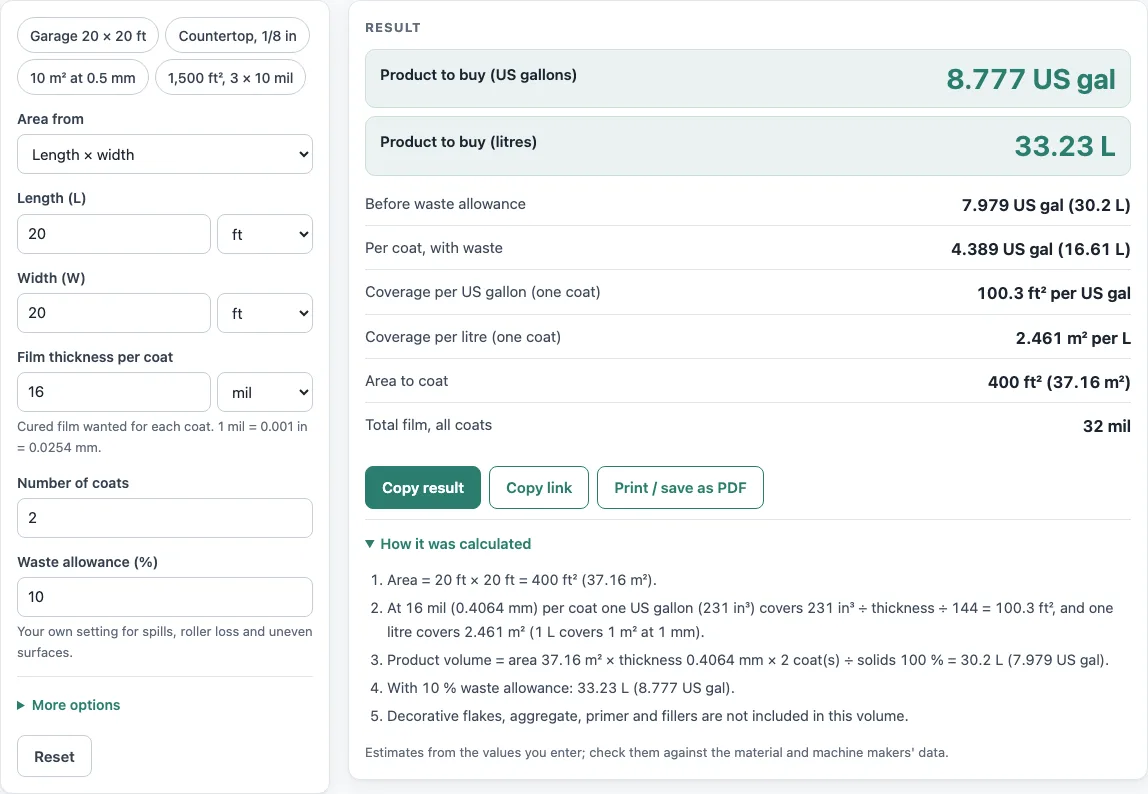
How to use the Epoxy Coverage Calculator
- Set the area. Enter a length and width to get the area, or type the area directly. Choose the unit: ft², m², in² or cm².
- Enter the film thickness per coat. Type the thickness and pick mil, mm or in.
- Enter the number of coats. Type how many coats you plan to apply.
- Set the waste allowance. The default is 10%. Change it to match how much product you expect to lose.
- Open More options and set volume solids %. The default is 100%, which suits most clear epoxies. Lower it if your product has a lower solids figure.
- Read the results. The product to buy appears in US gallons and litres, with the amount before waste, the amount per coat, coverage per gallon and per litre, the area and the total film thickness.
- Check the working. Open How it was calculated to see the formula and each step with your numbers.
Results update as you type, so you do not need a separate button. Copy result copies the result lines with a link. Copy link copies the page address, which stores every input, so opening it later restores the same calculation. Print / save as PDF prints the inputs, results, calculation steps and the date.
How much epoxy do I need for a garage floor?
Enter the floor’s length and width, the film thickness you plan to apply, and the number of coats. For a 20 × 20 ft garage floor with 2 coats of 16 mil, the calculator gives 8.78 US gal (33.2 L) with the default 10% waste.
The floor is 400 ft². At 16 mil, one gallon covers about 100 ft², so two coats need about 8 gallons before waste. The 10% allowance brings that to 8.78 gallons.
How many square feet does a gallon of epoxy cover?
One US gallon is 231 in³. Spread over 1 mil (0.001 in), that volume covers 1,604 ft². At any thickness in mil, coverage is 1,604 ÷ thickness ft² per gallon, assuming 100% volume solids. At 10 mil, one gallon covers about 160 ft². At 16 mil, it covers about 100 ft².
In metric, 1 litre at 1 mm covers 1 m².
How do I calculate epoxy coverage at a thickness in mils?
Divide 1,604 by the thickness in mil to get the square feet per gallon. Divide the total film area (area × coats) by that figure to get the gallons needed. Then add your waste allowance.
For example, 1,500 ft² in 3 coats of 10 mil gives 1,604 ÷ 10 = 160.4 ft² per gallon. The total film is 4,500 ft², which needs about 28.05 gallons. With 15% waste, the calculator gives 32.26 US gal (122.1 L).
How much epoxy for a bar top?
Measure the top’s length and width, then set the film thickness you plan to apply. The thickness has a large effect, because doubling it doubles the product needed.
For a 12 × 10 ft surface, such as a counter, at 1/16 in (62.5 mil) in one coat, the calculator gives 5.14 US gal (19.47 L) with the default 10% waste.
What does volume solids mean?
Volume solids is the percentage of the liquid product that remains as dry film after the solvent leaves. At 100%, all of the product becomes film. Most clear epoxies are treated as 100% solids in this calculator.
Below 100%, the wet film shrinks as the solvent evaporates, so the dry film is thinner than the wet film you applied. You need more product to reach the same dry thickness. The calculator uses: product = area × thickness × coats ÷ solids × (1 + waste). At 80% solids, for example, you need 1 ÷ 0.8 = 1.25 times as much product.
Sources
Checked October 2026:
- Spartan Chemical, mil thickness bulletin: 1 US gal = 231 in³ spread at 1 mil covers 1,604 ft²
- NIST SP 811 and NIST Handbook 44 appendix C for unit conversions (1 in = 25.4 mm, 1 US gal = 231 in³)
For estimation; verify critical designs against the applicable standard.
Worked examples
| Input | Result |
|---|---|
| 20 ft × 20 ft, 16 mil per coat, 2 coat(s) | 8.777 US gal (33.23 L) |
| 10 m², 0.5 mm per coat, 1 coat(s) | 1.321 US gal (5 L) |
| 10 m², 0.5 mm per coat, 1 coat(s) | 2.642 US gal (10 L) |
| 12 ft × 10 ft, 0.0625 in per coat, 1 coat(s) | 5.143 US gal (19.47 L) |
| 1500 ft², 10 mil per coat, 3 coat(s) | 32.26 US gal (122.1 L) |
Calculated by the tool above with these values.
Frequently asked questions
Does the calculator include flakes, aggregate or primer?
No. It only works out the epoxy product. Buy flakes, aggregate and primer separately and add them to your order.
Does the result include waste?
Yes. The product to buy includes your waste allowance, which defaults to 10%. The amount before waste is shown separately, so you can see how much the allowance adds.
What is the difference between the amount before waste and the amount to buy?
The amount before waste is the product the area, thickness, coats and solids require. The amount to buy is that figure plus your waste allowance, so it is the number to order.
Can I use the results in a quote?
Yes. Results may be used in commercial work, including quotes, price lists, job sheets and reports, without attribution. Print / save as PDF gives you a dated copy of the inputs and steps.
How many coats of epoxy does a floor need?
That depends on the system you use; follow the maker’s coating schedule and enter the number of coats and the thickness per coat it gives.
Can I enter the area in square metres?
Yes. Area can be typed in ft², m², in² or cm², or worked out from length and width in any of those units.
Related tools
- Epoxy resin calculator: use it when you want to check resin quantities with a separate calculator.
- Mil to mm converter: use it when you have a film thickness in mil and need it in mm, or the reverse.
- Plastic weight calculator: use it when you need the weight of a plastic part rather than the amount of coating.
- Plastic density chart: use it when you need the density of a plastic to convert between weight and volume.
- All calculators: use it to find a different tool on this site.