Plexiglass Thickness Chart
Pick a sheet thickness and enter its length and width to see the weight, with every common acrylic thickness in inches and mm.
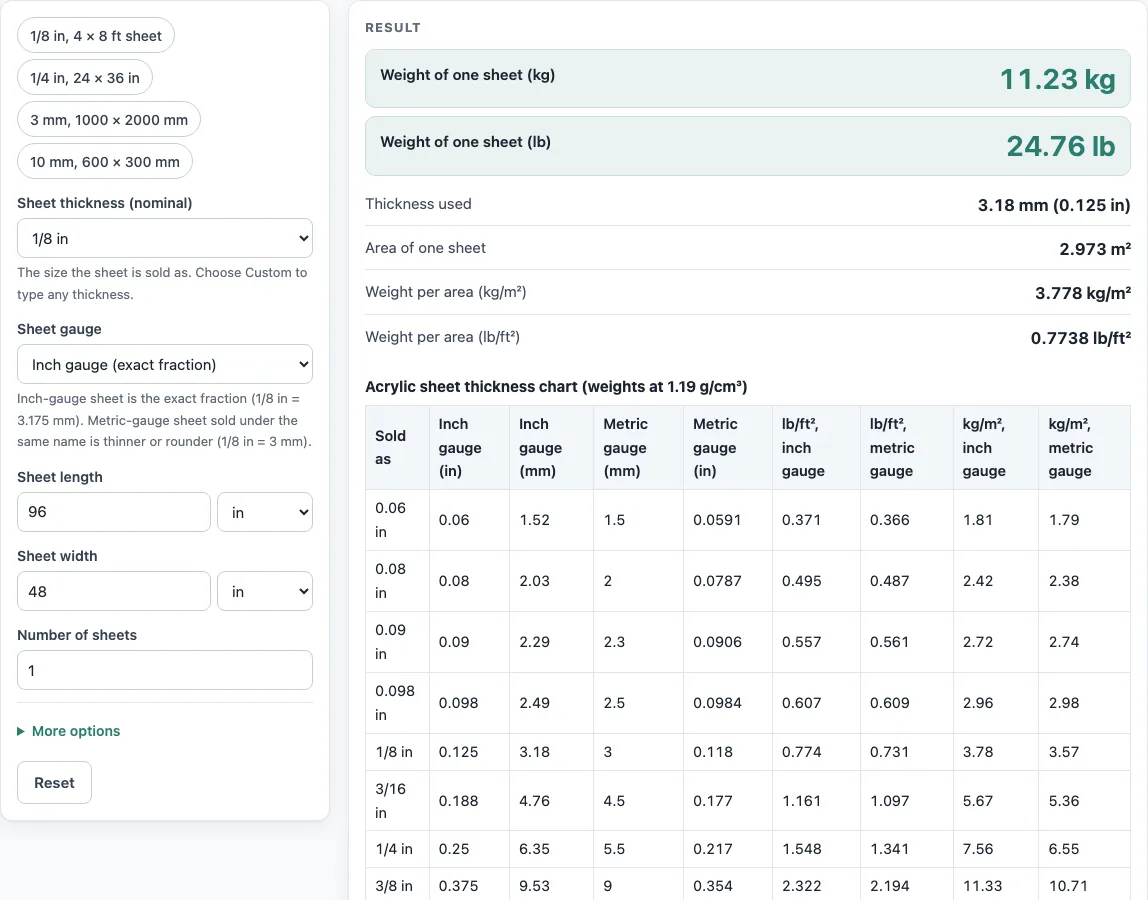
This plexiglass thickness chart lists 16 acrylic sheet sizes, from 0.06 in to 3 in, with each thickness in inch gauge and in metric gauge, in inches and millimetres. It also estimates how much a sheet weighs. Plexiglass is a common name for acrylic sheet, so the chart is written for either. The tool is free, runs in your browser, and needs no sign-up.
Use it to check the exact thickness of a sheet before you buy or cut, or to estimate the weight of a sheet before you move it. The chart shows both gauges because a sheet sold as 1/8 in is not always exactly 1/8 in thick. The results are estimates based on the sheet size and density you enter.
How to use the acrylic sheet thickness chart
- Open the Sheet thickness (nominal) list and choose one of the 16 sizes, such as 1/8 in. If your sheet is not on the list, choose Custom thickness.
- If you chose a standard size, open Sheet gauge and pick Inch gauge (exact fraction) or Metric gauge (e.g. 3 mm sold as 1/8 in). Use the gauge that matches the label on your sheet or supplier’s listing.
- If you chose Custom thickness, the gauge option disappears. Type your value in the Thickness box, in in or mm.
- Enter Sheet length and Sheet width. Type a number and pick the unit (in, ft, mm, cm or m) for each.
- Enter Number of sheets. It defaults to 1.
- To change the density, open More options and set Density in g/cm³, kg/m³ or lb/ft³. The default is 1.19 g/cm³.
- Read the result rows: Weight of one sheet (kg and lb), Total weight (shown when you have more than one sheet), Thickness used, Area of one sheet, and Weight per area (kg/m² and lb/ft²). The chart table below lists all 16 sizes in both gauges.
Use Copy result to copy the numbers, or Copy link to share a link that keeps all your inputs. Print / save as PDF prints your inputs, results, steps and the date. How it was calculated shows each step with your numbers. Reset clears the form.
How thick is 1/8 inch plexiglass in mm?
In inch gauge, 1/8 inch is exactly 3.175 mm, because 1 in equals 25.4 mm (the tool shows it rounded as 3.18 mm). In metric gauge, a sheet sold as 1/8 in is 3 mm (0.118 in). The gauges differ more as sheets get thicker, so pick the one that matches your supplier’s label.
What are the standard acrylic sheet thicknesses?
The chart lists 16 sizes: 0.06, 0.08, 0.09, 0.098, 1/8, 3/16, 1/4, 3/8, 1/2, 3/4, 1, 1-1/4, 1-1/2, 2, 2-1/2 and 3 in. The metric-gauge values come from one distributor’s table (Acme Plastics): for example 3/16 in is 4.5 mm, 1/4 in is 5.5 mm, 3/8 in is 9 mm, 1/2 in is 12 mm, 3/4 in is 18 mm and 1 in is 24 mm. Another seller may stock different thicknesses, so use this as a guide. Thickness tolerances are not shown, because no manufacturer data sheet with them was found. Exact tolerance varies by maker and product.
How much does a sheet of acrylic weigh?
Weight depends on length, width, thickness and density. The formula is weight = length × width × thickness × density. For example, 1 m² of 3 mm sheet is 0.003 m³ in volume. At 1,190 kg/m³ it weighs 3.57 kg. A full 96 × 48 in sheet of 1/8 in inch gauge works out to 11.23 kg (24.76 lb), or 3.778 kg/m². Thicker sheets of the same area weigh more in direct proportion.
Is 1/4 inch acrylic really 6.35 mm?
Yes, in inch gauge. 1/4 in × 25.4 mm = 6.35 mm exactly. A sheet sold in metric gauge as 1/4 in is 5.5 mm, according to the Acme Plastics table. Check which gauge your supplier uses before you order or cut to size.
What is the density of acrylic?
The tool uses 1.19 as the specific gravity (ASTM D792) printed on Plaskolite OPTIX acrylic data sheets. With water set to 1, this is 1.19 g/cm³, or 1,190 kg/m³. That is about 74.3 lb/ft³. Other products can differ, so change the value in More options if your data sheet gives a different number.
Sources
Checked October 2026:
- Plaskolite OPTIX L data sheet and OPTIX LD data sheet: specific gravity 1.19 (ASTM D792), used as the density
- Acme Plastics, acrylic sheet thickness information: the sizes sheets are sold as and their metric-gauge thicknesses in mm
- Inch to mm uses 1 in = 25.4 mm and pounds use 1 lb = 453.59237 g (exact definitions). Thickness tolerances are not listed: they differ by maker and product, so read your supplier’s data sheet
For estimation; verify critical designs against the applicable standard.
Worked examples
| Input | Result |
|---|---|
| 1/8 in, 96 in × 48 in, 1 sheet(s) | 11.23 kg (24.76 lb) per sheet |
| 1/4 in, 36 in × 24 in, 1 sheet(s) | 4.21 kg (9.29 lb) per sheet |
| 1/8 in (metric gauge), 2000 mm × 1000 mm, 4 sheet(s) | 7.14 kg (15.74 lb) per sheet |
| 10 mm, 600 mm × 300 mm, 1 sheet(s) | 2.14 kg (4.72 lb) per sheet |
Calculated by the tool above with these values.
Frequently asked questions
Is the calculator free, and is anything I type uploaded?
Yes, it is free and needs no sign-up. It runs in your browser, and nothing you type is uploaded.
How much do 4 sheets of acrylic weigh?
Enter the size, choose the gauge and set Number of sheets to 4. For example, four metric-gauge 1/8 in sheets of 2000 × 1000 mm weigh 7.14 kg each, or 28.56 kg in total.
Why does the calculator show a density warning?
A warning appears when the density you enter differs by more than 10 % from 1.19 g/cm³. Check that the density matches your material’s data sheet.
What is 1/4 inch plexiglass in mm?
The exact conversion is 6.35 mm, which is the imperial gauge in the chart. Sheet sold in metric sizes as “1/4 in” is listed at 5.5 mm, so check which gauge your supplier means before you cut or order parts.
How much does a 4 × 8 sheet of 1/4 inch acrylic weigh?
About 22.46 kg (49.5 lb) with the inch gauge of 6.35 mm and a density of 1.19 g/cm³. That is 7.56 kg per square metre, or 1.55 lb per square foot. A 1/8 in sheet of the same size weighs half as much.
Does the chart show thickness tolerances?
No. No manufacturer data sheet with tolerances was found, and tolerance varies by maker and product. The results are estimates.
Related tools
- Plastic weight calculator: estimate the weight of plastics other than acrylic.
- Plastic density chart: compare densities before you change the density setting.
- Mil thickness chart: use it when your film or sheet thickness is given in mils.
- Shore hardness chart: compare how hard or soft a plastic or rubber is.
- All calculators: browse every calculator on this site.